How to Stay Focused Working from Home — 10 Proven Strategies
Category: Productivity | Reading time: 12 min | Last updated: June 2026
Disclosure: This post contains affiliate links. If you buy through our links we may earn a small commission at no extra cost to you.
Working from home should make you more productive. No commute, no open-plan office noise, no one stopping by your desk to talk about the weekend. And yet most people who work from home will tell you honestly focus is harder at home than it ever was in the office.
The reasons are everywhere. Your phone is always within reach. Your kitchen is ten steps away. The line between work time and personal time blurs into nothing. Notifications don’t stop just because you’re trying to think. And nobody is watching, which means the social accountability that kept you at your desk in the office simply doesn’t exist anymore.
The good news: this is a solved problem. Not by willpower — willpower is finite and unreliable. By environment design, systems, and a few evidence-backed techniques that actually work for the specific conditions of remote work.
Here are 10 of them.
Focus is one part of remote work success — our complete guide to working from home covers the full setup from workspace to routines.
1. Time blocking — schedule focus like a meeting
Most remote workers have a to-do list. What they don’t have is a scheduled time to actually do the things on it. The result: the list grows, meetings fill the calendar, and focused work gets pushed to whatever scraps of time are left.
Time blocking fixes this by treating focused work like an appointment. You block 9am–11am for deep work the same way you’d block it for a client call. That time is not available for email, Slack, or anything else.
The research behind it: Cal Newport’s Deep Work framework — developed over years studying high-output professionals — found that scheduled, distraction-free focus blocks produce more meaningful work per hour than fragmented availability. Knowledge workers who protect deep work time consistently outperform those who don’t regardless of raw hours worked.
How to implement it:
- Block 2-3 hour chunks in your calendar for your most cognitively demanding work
- Put these blocks in the morning when mental energy is highest for most people
- Treat them as non-negotiable — decline meetings that conflict
- Use a physical or digital calendar so the blocks are visible
The key shift: stop managing a to-do list and start managing your time. What gets scheduled gets done.
2. The Pomodoro Technique — work in timed sprints
Developed by Francesco Cirillo in the late 1980s, the Pomodoro Technique is one of the most studied focus methods available. The principle is simple: work for 25 minutes with complete focus, take a 5-minute break, repeat. After four cycles take a longer 15-30 minute break. This is the number one way I personally stay focused in my home office. It helps me so much to split my work into 25 minutes.
The reason it works isn’t mysterious. Knowing you only have to focus for 25 minutes makes starting easier — the task feels less overwhelming. The mandatory breaks prevent the mental fatigue that accumulates during long uninterrupted sessions. And the ticking timer creates a mild urgency that crowds out distraction.
The research behind it: Multiple peer-reviewed studies on structured work intervals have found that regular breaks improve sustained attention over long work sessions. The brain’s attention systems fatigue under continuous demand — brief recovery periods reset them.
The tool that makes it work:
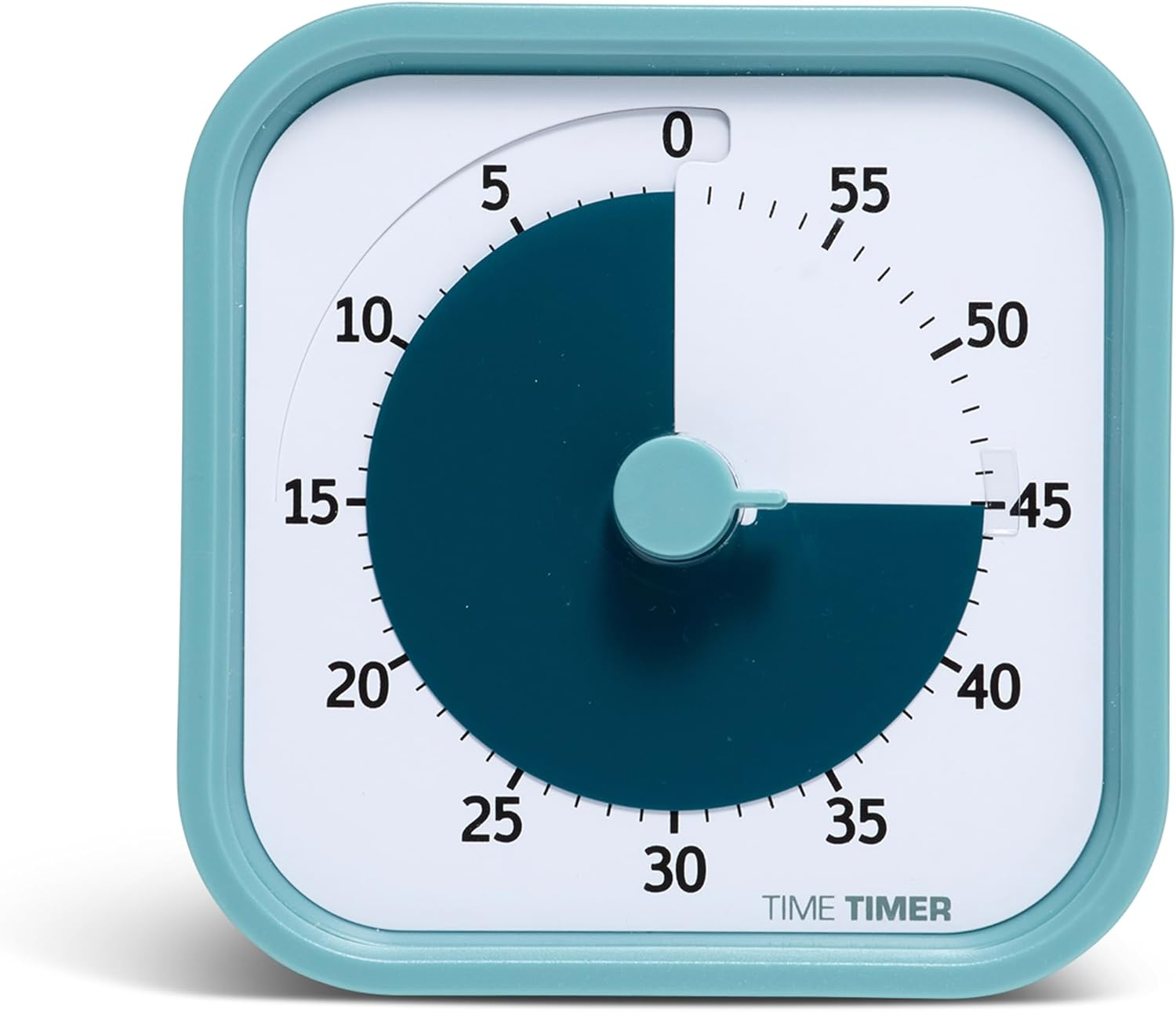
A physical timer beats a phone timer for one specific reason — using your phone to set a timer means your phone is on your desk and you’re one notification away from losing the session. The Time Timer is a visual analog timer that shows remaining time as a shrinking red disk. No phone required.
How to implement it:
- Start with 25-minute work blocks, 5-minute breaks
- If 25 minutes feels too short, try 45/15 or 90/20 intervals — find what works for your concentration pattern
- During breaks move away from your desk — don’t scroll your phone
- Track your Pomodoros — knowing you completed 8 focused sessions in a day is genuinely motivating
A physical timer is the way to go, but if you do not want to spend money, I also use PowerPom from the Microsoft store when I am travelling.
3. The phone-in-another-room rule
This one sounds extreme. It works.
A 2017 study from the University of Texas at Austin found that the mere presence of a smartphone on a desk — even face down, even silent — reduces available cognitive capacity. The brain expends resources actively resisting the urge to check it. The only condition that eliminated this effect was having the phone in another room entirely.
Put differently: you cannot fully concentrate with your phone on your desk. The willpower cost of not checking it is real and measurable.
How to implement it:
- During focused work blocks leave your phone in another room or in a bag
- If you need to be reachable set specific check-in times — 9am, 12pm, 3pm — and let people know
- Use Do Not Disturb on your computer for the same sessions
- If you use your phone as a timer swap it for a physical timer
The resistance to this strategy is almost always “but what if there’s an emergency.” There is almost never an emergency. And if there is, people will find a way to reach you.
Physical discomfort is one of the most overlooked distractions — our seat cushion guide covers simple fixes for tailbone and lower back pain that won’t break the bank.
4. Design your environment for focus
BJ Fogg’s research at Stanford’s Behavior Design Lab established something important: behavior change is much easier when the environment makes the desired behavior automatic. Willpower is a backup system — environment is the primary driver.
For remote workers this means your desk setup directly affects your ability to focus. A cluttered desk creates visual noise that competes for attention. A clean, organized workspace signals to your brain that it’s time to work — the same way a gym signals it’s time to exercise.
Clearing cables from your desk surface is one of the fastest visual declutter wins — our wireless keyboard and mouse guide covers the best options at every budget.
The practical changes that make a difference:
A clear desk surface — everything not needed for the current task off the desk. A desk pad creates a defined workspace boundary. Desk organizer keeps frequently needed items accessible without visual chaos.
Check desk organizers on Amazon →
A dedicated workspace if possible — working from the same couch you watch TV on makes it harder for your brain to switch into work mode. Even a specific corner of a room with a dedicated desk is enough. The location becomes a trigger. If you’re still working from a makeshift setup, our complete $500 home office guide covers everything you need to build a proper dedicated workspace without overspending.
Natural light — research from Cornell University found that workers in naturally lit offices reported 84% fewer headaches and eyestrain issues than those in artificially lit spaces. Face a window if you can.
A plant — studies published in the Journal of Environmental Psychology found that office plants reduce stress and improve concentration. The effect is modest but real, and a pothos costs $26.
Check Costa Farms Pothos on Amazon →

5. Manage noise — actively, not passively
The University of California Irvine published research showing it takes an average of 23 minutes and 15 seconds to fully regain focus after an interruption. A single noise distraction that breaks your concentration doesn’t cost you 30 seconds — it costs you the next 23 minutes of recovery time.
At home the interruption sources are constant: delivery drivers, neighbors, partners, children, pets, traffic, appliances. You can’t eliminate them. You can block them.
Three levels of noise management:
Level 1 — Earplugs for deep silence
Physical foam or silicone earplugs block sound passively and work in complete silence. No battery, no technology, no distractions from the device itself. Loop Quiet earplugs are the most recommended option for extended desk work — comfortable enough for hours, effective enough to matter.

Level 2 — Active Noise Cancellation for ambient noise
ANC headphones electronically cancel continuous ambient noise — HVAC, traffic, background conversation. Better than earplugs for variable noise environments. See our full guide to the best noise cancelling headphones for working from home for specific recommendations.
For full over-ear noise cancellation during deep work sessions, see our complete guide to noise cancelling headphones for remote workers — covering everything from $45 budget options to professional Jabra gear.
Level 3 — White or brown noise
Some people focus better with consistent background sound than in complete silence. Apps like Brain.fm or simply a YouTube brown noise video provide a consistent audio environment that masks variable interruptions without demanding attention.
6. Batch your communication
Email and Slack are the most significant focus killers in remote work — not because the messages themselves are disruptive but because the habit of checking them constantly is. Every check is a context switch. Every context switch has a recovery cost.
The research: A study by the American Psychological Association found that multitasking — defined as switching between tasks — reduces productivity by up to 40%. Email checking is task-switching dressed up as work.
The fix is batching: check and respond to email and Slack at specific scheduled times rather than continuously throughout the day. Three times per day — morning, midday, late afternoon — is enough for most remote roles.
How to implement it:
- Turn off email notifications entirely — they serve the sender’s urgency, not your focus
- Set Slack to Do Not Disturb during focus blocks
- Put your email checking times in your calendar so colleagues can predict your response windows
- Set an auto-responder or Slack status explaining your communication schedule if your role requires it
The pushback from this is always “my job requires fast responses.” For most remote workers this isn’t actually true — it’s a habit dressed up as a requirement. Test it for one week and measure whether anything actually broke.
7. The two-minute rule
From David Allen’s Getting Things Done — one of the most influential productivity frameworks ever written. The rule: if a task takes less than two minutes, do it immediately rather than adding it to your to-do list.
The reasoning is simple. The mental overhead of tracking a small task — writing it down, remembering it, coming back to it — costs more time and energy than just doing it. A to-do list full of two-minute tasks is a source of low-grade anxiety that competes for attention during focused work.
How to implement it:
- Reply to a short email immediately rather than flagging it to deal with later
- File a document when you create it rather than leaving it on the desktop to organize later
- Make the coffee before sitting down rather than thinking about it for an hour
The two-minute rule doesn’t apply during a deep work block — during those sessions nothing interrupts. It applies during transition times, between tasks, and at the start and end of the workday.
8. Movement breaks — your brain needs your body to move
Prolonged sitting doesn’t just affect your body — it affects your brain. Research published in the British Journal of Sports Medicine found that sedentary behavior is associated with reduced cognitive function, including attention and processing speed.
Brief movement breaks — even 5 minutes of walking — have been shown to improve focus and mood for the subsequent work session. The mechanism is blood flow: movement increases circulation to the brain which directly supports cognitive performance.
Practical movement options for remote workers:
A standing desk lets you alternate between sitting and standing throughout the day — the position change alone is enough to reduce afternoon mental fatigue for many people. Our full standing desk guide covers options from $113 to $500.
An under-desk elliptical lets you move during passive work — calls, reading, reviewing documents. The Cubii specifically is quiet enough to use on video calls without anyone noticing.

Scheduled walking breaks — even 10 minutes outside between deep work blocks resets attention and provides a genuine mental break that scrolling your phone doesn’t.
9. Get your thinking out of your head
Your working memory — the mental space where you hold active thoughts — has a limited capacity. When it’s full of tasks, worries, ideas, and reminders it has less room for the actual work you’re trying to do. Psychologists call this cognitive load.
The fix is an external brain — a system outside your head that holds the things your brain would otherwise spend resources tracking.
If meeting notes are eating into your focus time our HappyScribe review covers an AI transcription tool that handles it automatically.
The research: David Allen’s GTD framework and subsequent research on externalization found that capturing tasks and ideas in a trusted external system reduces anxiety and frees cognitive resources for focused work.
Two tools that work:
A whiteboard for visual task planning — seeing your priorities for the day on a board in front of you keeps them present without requiring your brain to hold them. When you finish something, you erase it. That physical act of completion is surprisingly satisfying and motivating.

A dedicated notebook for capture — writing things down by hand improves retention and processing in a way typing doesn’t. Research from Princeton University and UCLA found that longhand note-takers outperformed laptop note-takers on conceptual questions because writing forces synthesis rather than transcription.
I personally keep separate notebooks for different projects — when the notebook is full the project is done. Weirdly motivating.
Check Leuchtturm1917 notebooks on Amazon →

10. The shutdown ritual — end work deliberately
One of the most underrated focus strategies for remote workers has nothing to do with working hours — it’s what you do at the end of them.
Without a commute there’s no physical transition between work mode and home mode. Work can bleed into evenings indefinitely. And when it does, your brain never fully recovers — you arrive at the next morning’s work session already partially depleted.
A shutdown ritual creates the transition artificially. It’s a brief end-of-day sequence that signals to your brain that work is over.
The research: Research on psychological detachment from work — the ability to mentally disconnect during off hours — consistently shows it improves next-day performance, creativity, and wellbeing. People who mentally detach in the evening outperform those who remain mentally “at work.”
A simple shutdown ritual:
- Review your task list — note what’s done, what carries forward
- Write tomorrow’s top three priorities in your notebook or on your whiteboard
- Close all work tabs and applications
- Say out loud “shutdown complete” — Cal Newport’s specific recommendation, which sounds ridiculous until you try it and realize it actually works as a mental trigger
- Walk away from your desk and don’t return
The ritual doesn’t need to take more than 10 minutes. The consistency of doing it every day at the same time is what makes it effective — your brain learns the pattern and begins to downshift in anticipation.
The honest truth about focus
None of these strategies require significant willpower once they become habits. That’s the point. Willpower is depleted by use — it’s not a reliable foundation for consistent focus across a full work week.
Environment design, systems, and structured techniques work because they make the right behavior automatic rather than effortful. A phone in another room doesn’t require willpower to not check. A scheduled focus block doesn’t require deciding to focus — the decision is already made.
Pick two or three of these strategies and implement them consistently for two weeks before adding more. Trying to overhaul everything at once is how none of it sticks.
The remote workers who are most productive aren’t more disciplined than anyone else. They’ve just built systems that make focus the path of least resistance.
Quick reference — the 10 strategies
| Strategy | The science | Time to implement |
|---|---|---|
| Time blocking | Cal Newport’s Deep Work | 15 minutes of calendar setup |
| Pomodoro Technique | Attention fatigue research | Immediate |
| Phone in another room | University of Texas study | Right now |
| Environment design | BJ Fogg’s behavior research | 30 minutes of desk setup |
| Noise management | UCI interruption research | Immediate |
| Batch communication | APA multitasking research | One settings change |
| Two-minute rule | David Allen’s GTD | Immediate |
| Movement breaks | British Journal of Sports Medicine | Schedule it |
| External brain | Princeton/UCLA note-taking research | 10 minutes |
| Shutdown ritual | Psychological detachment research | 10 minutes daily |
Want the physical tools to back these strategies?
Ready to upgrade your workspace?
Need a better chair for those long focus sessions?
Frequently asked questions
How long does it take to build better focus habits?
Research on habit formation suggests 66 days on average for a new behavior to become automatic — not the often-cited 21 days. Give any of these strategies at least 6-8 weeks before judging whether they work for you.
What if my job requires constant availability?
Genuinely always-on roles are rarer than people think. Most remote roles have an expectation of responsiveness that can be met with three scheduled communication check-ins per day. If you’re unsure have an explicit conversation with your manager about response time expectations — you may find more flexibility than you assumed.
Does music help or hurt focus?
It depends on the task. Research suggests music without lyrics helps for routine tasks but hurts performance on tasks requiring language processing — writing, reading, complex analysis. Instrumental music or brown noise is generally safer than music with lyrics during cognitively demanding work.
Is working from a coffee shop better than working from home?
For some people yes — the ambient noise and social accountability of a public space improves focus compared to an isolated home office. This is called the “coffee shop effect” and is a documented phenomenon. If you consistently struggle to focus at home experimenting with a different environment one day per week is worth trying.
All product links in this post go to verified Amazon listings. Prices are approximate and subject to change.