Best Noise Cancelling Headset With Mic for Working From Home (2026)
Category: Tech & Gear | Reading time: 15 min | Last updated: November 2026
Disclosure: This post contains affiliate links. If you buy through our links we may earn a small commission at no extra cost to you.
A headset and a pair of headphones are not the same purchase. Headphones are judged on how they sound to you. A headset is judged on how you sound to everyone else, and that is decided almost entirely by one piece of hardware: whether there is a boom arm reaching toward your mouth or a microphone buried in the earcup.
Here is the part nobody mentions. The boom mic is in the cheaper options. The most expensive headset of the three below dropped it, and it is the only one of the three that is not certified for Microsoft Teams. If you are buying a headset so that people stop asking you to repeat yourself, spending more is actively working against you.
These three are the ones worth your time. One is the default for good reason, one is the best microphone for the money, and one is for people who refuse to wear a boom on camera.
Jump to a section
- The short answer
- The boom mic is the whole decision
- Jabra Evolve2 65 Flex in detail
- Poly Voyager Focus 2 in detail
- Logitech Zone Vibe Pro in detail
- Specs side by side
- The spec nobody lists: Teams certification
- How to read these ratings
- The Bluetooth range problem
- Headset or headphones
- Which one to buy
- FAQ
The short answer
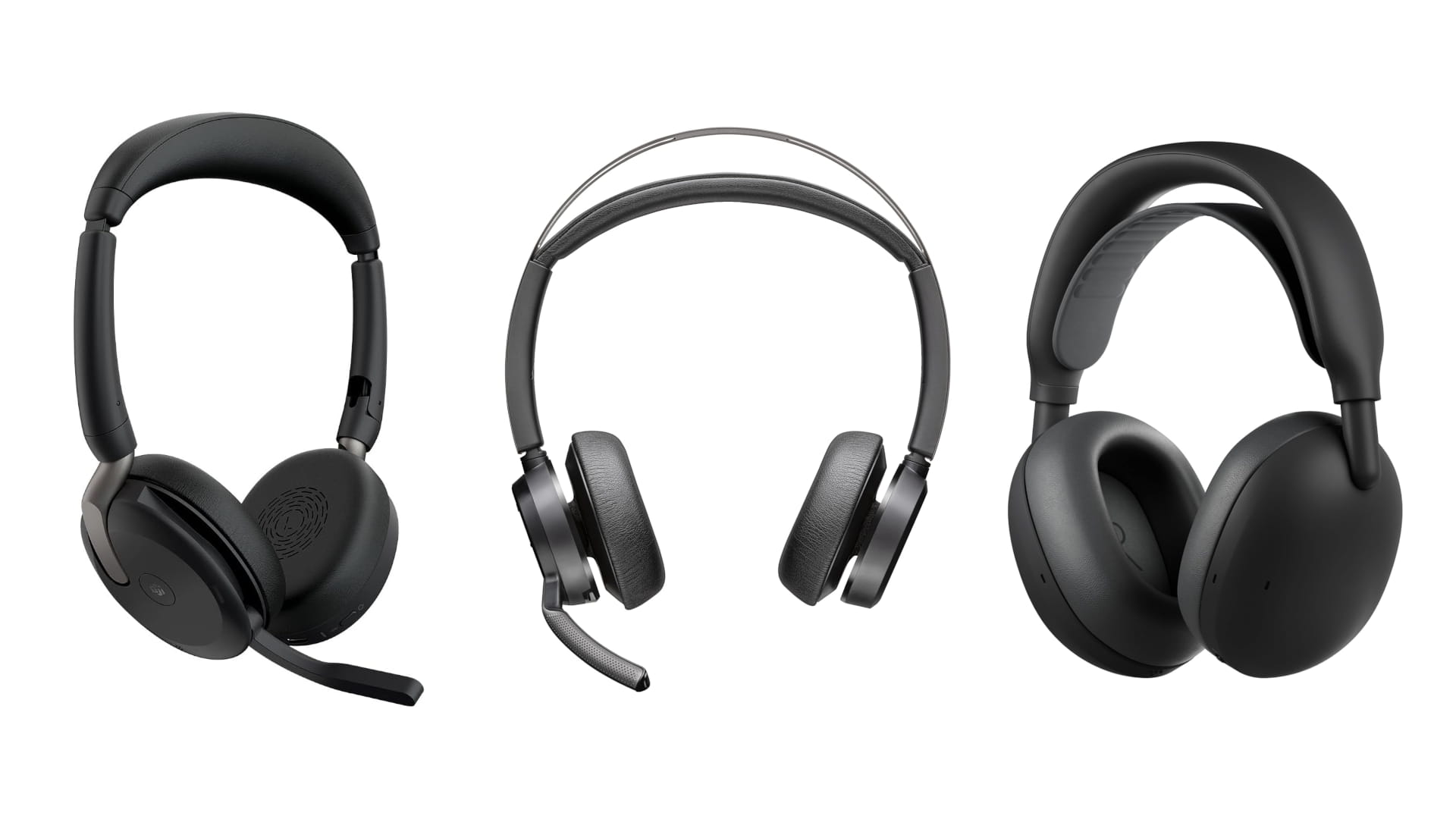
Buy the Jabra Evolve2 65 Flex. It is the one that solves the problem everyone actually has with a headset, which is that a boom mic makes you sound great and makes you look like you work in a call center. The Jabra’s boom stows against the headband when you are not on a call, and the whole thing folds into a pouch small enough to forget about in a bag. It sells more than twice as many units a month as anything else here.
Buy the Poly Voyager Focus 2 if the microphone is the only thing you care about. It costs less than the Jabra and has the more serious microphone array of the two, and the praise for how it sounds to callers is the one thing every reviewer agrees on, including the ones who gave it three stars. It is heavier and the boom does not hide.
Buy the Logitech Zone Vibe Pro only if you will not wear a boom. It is the most expensive of the three, it has the thinnest review history by a wide margin, and it is the only one not certified for Teams. What it buys you is a headset that reads as ordinary headphones on camera and sounds good enough to keep wearing after work.
The boom mic is the whole decision
Microphones do not care how expensive they are. They care how far away your mouth is. A boom arm puts the capsule two or three inches from your lips, which means your voice arrives enormously louder than the dishwasher, the dog, or your kid on the stairs. No amount of processing in an earcup mic eight inches away can make up that gap, because the processing has to guess which sound is you.
That is why business headsets have looked the same for twenty years. It is not conservatism, it is physics.
So the decision tree is short. If you take calls from a room with other people or other noise in it, you want a boom, and both boom options here cost less than the one without. If you are on camera all day and the boom bothers you, or if you want one set of cans for calls and music both, you give up real microphone performance to get that. There is no third option where you pay more and get both, at least not in this price range.
One thing that is not a real difference: active noise cancellation. All three have it, all three are decent at it, and none of them are Sony or Bose. ANC affects what you hear, not what callers hear. People conflate the two constantly and then buy the wrong headset.
Jabra Evolve2 65 Flex in detail

The Flex is the one to buy because it is the only headset here that does not force the boom-or-looks trade. The arm folds up against the headband, so on a video call with the mic stowed it reads as a normal pair of over-ear headphones, and when you need it you rotate it down and sound like you are in a studio.
The folding matters more than it sounds. The earcups twist flat and the headset goes into a pouch roughly half the size of the case the older Evolve 65 shipped in. If you ever work somewhere other than your desk, that is the difference between bringing it and leaving it.
The most useful review on the listing comes from someone who has owned several generations of this exact product line, and his complaint is specific enough to be worth planning around.
“By far my favorite work headphones have been Jabra Evolve 65 (original) with a boom mic. I’ve used them in environments where there was so much background and wind noise that I could barely hear myself, but never had someone ask me to repeat what I said. I loved that a quick flip of the boom mic up, just 45 degrees, muted me. The Evolve2 65s are smaller and lighter than my old 65s. The sound is pretty good, and noise cancelling seems to work about as well. The boom mic was a little disappointing though in that you have to have to completely stowed to mute. The old ones only required you move the boom to just above eye level. Also with the boom mic stowed, it’s impossible to know if you are muted without checking your mic status in the call, or feeling for it. I love that these are more compact. When you put them back in the case they take up about half the space the old case took up. The battery life is a huge upgrade from my old 65s, even when they were new.”
Read that mute complaint carefully, because it is the one thing that will annoy you daily. Mute is tied to the boom being fully stowed, which means mute and the headset’s tidy look are the same position. You cannot glance down and tell whether you are muted. Two separate reviewers mention fighting with mute state, one of them describing Teams showing the mic live with the arm closed until he swung it back and forth to resync.
Everything else people raise is minor. The cups press against each other inside the pouch, enough that one owner slips a piece of paper between them. Reconnecting to a phone over Bluetooth after the headset sleeps takes long enough that you briefly think it is off. Battery runs around six hours of talk time in practice, which is a working day with a lunch break but not two.
Who it’s for. Anyone who takes several calls a day from a house with other life happening in it, and especially anyone who sometimes works from a kitchen table, a hotel, or an office two days a week. It is the safe answer and the data agrees, at more than 500 sold a month.
Poly Voyager Focus 2 in detail

This is the cheapest headset on the page and it has the most microphone hardware. Acoustic Fence uses several microphones to work out where your voice is coming from and treat everything outside that zone as noise to discard, which is a layer the Jabra does not advertise.
What makes it convincing is not the marketing, it is that the microphone is the only thing every single reviewer agrees on. The five-star owners praise it. The four-star owner who thinks the headset is too heavy praises it. The three-star owner who is furious about Bluetooth range opens his review by calling the mic noise cancelling excellent. When a product’s critics agree with its fans about one feature, that feature is real.
It also has the single best small feature here. Dynamic Mute Alert notices when you are speaking while muted and tells you, which is the exact problem the Jabra’s stowed boom creates.
“Microphone Noice cancell works excelent. Is absolutly confortable. ANC is ok, is not like Bose or Sony but reduce street noise. I am absolutly frustrated with the Bluethoth range.. is like 15 feets / 4 meters? On product information wireless range is 164 ft/ 50 m. This happend to me with pc connected with usb and also on phone Bluetooth. worst range of all my headphones ever. I have last software and BT700 drivers update… What happend??”
That complaint deserves its own section further down, because another owner bought this headset specifically to roam and says nothing comes close. Both are verified purchases and they cannot both be describing the same experience.
The real and undisputed drawback is weight. One longtime Poly customer moved to this from a lightweight in-ear model and never stopped noticing, and he also found the boom needs precise placement. His words were that people find it hard to hear him if the mic is off by even a little, and that the headset’s weight lets the boom drift as he moves. He still recommended it.
Who it’s for. Someone who is on calls most of the day, sits still while doing it, and is judged on how they sound. Sales, support, recruiting, anyone running client calls from a noisy house. If the headset is a tool rather than a lifestyle purchase, buy this one and keep the difference.
Logitech Zone Vibe Pro in detail

This one exists for a real reason, and the reason is not acoustic. Plenty of people are on camera for hours a day and do not want a plastic arm across their face in every recording and every screenshot. The Zone Vibe Pro looks like headphones because it is headphones, with the mic in the earcup and software doing the work the boom would have done.
It is also the most comfortable-sounding of the three on paper and the best for music, with larger drivers and the longest battery life here by a wide margin. If you want one set of cans for the workday and the walk afterward, this is the only candidate.
Three things make me hesitant to call it more than a situational pick.
- It has 34 ratings. The other two have around 190 each. A 4.6 average on 34 ratings tells you much less than a 4.0 on 197, and it only takes a handful of bad units to move it.
- It is the most expensive of the three. You are paying a clear premium over both boom headsets to get worse call performance, which is a legitimate trade but worth naming.
- It is not certified for Microsoft Teams. Both of the others are. More on what that actually costs you below.
The critical review is also pointed, and it comes from someone who wanted to like it.
“I wanted to like these a lot, but the noise cancelling and transparency mode are much to be desired, I put them up against my Dyson Ontracs which you can also find around the same price blow these out the water with sound, transparency, and ANC… I still have because I am a collector and these are very comfortable which I may just use at computer for casual gaming, but unless a firmware update fix the ANC and transparency these will just be a niche for me.”
That is a fair hit. If the pitch is that this is the headset you also use for music, then losing to consumer headphones at the same money on sound and noise cancelling undercuts the whole case. The five-star owners describe excellent sound and ANC that works in an airport, so experiences vary, but there are not many of them yet.
Who it’s for. On camera all day, calls from a quiet room, and you want to keep wearing them after you log off. If any of those three is untrue, buy a boom.
Specs side by side
| Jabra Evolve2 65 Flex | Poly Voyager Focus 2 | Logitech Zone Vibe Pro | |
|---|---|---|---|
| Rating | 4.0 / 197 | 4.1 / 192 | 4.6 / 34 |
| Bought last month | 500+ | 300+ | 100+ |
| Microphone | Boom, stows in headband | Boom, Acoustic Fence array | Built-in, AI voice isolation |
| Noise cancelling | Hybrid ANC | Hybrid ANC, three levels | Adaptive ANC |
| Teams certified | Yes | Yes | No |
| Battery | Around 6 hours in practice | Up to 19 hours talk time | Up to 30 hours listening |
| Mute feedback | None when boom stowed | Dynamic Mute Alert | Via Logi Tune |
| Folds for travel | Yes, flat into pouch | No | No |
| Dongle | USB | BT700 USB-A or USB-C | Bluetooth multipoint |
| Charging | USB-C | USB-C | USB-C |
| Colors | Black | Black | Black, off-white, lilac |
| Fit | Over ear, rotating cups | Over ear, plush cushions | Over ear, dual-layer pads |
The spec nobody lists: Teams certification
Every listicle about work headsets mentions Teams certification and none of them explain it, so it reads like a sticker. It is not. Microsoft publishes the list of personal peripherals it has certified along with what certification actually guarantees, and the guarantees are the daily annoyances you would otherwise live with.
- It works plugged in with no setup, and registers itself with the Teams client instead of needing you to pick it from a dropdown.
- The physical buttons do what they say. Answer, hang up, mute, volume, all from the headset.
- Wideband audio with echo cancellation, tested for no echo, distortion or dropouts.
- Teams picks it as the default device when you have several audio things connected, which is the problem anyone with a webcam, speakers and a headset has had.
- Newer certified models get a dedicated Teams button with an LED and notifications pushed from the client.
The Poly Voyager Focus 2 appears on Microsoft’s list by name. Jabra states certification for Teams, Zoom and Google Meet on the Evolve2 65 Flex listing. The Logitech Zone Vibe Pro makes no such claim, and Logitech’s certified models are a different product line entirely, the Zone Wired and Zone Wireless business headsets.
Two limits worth knowing even on a certified headset. Microsoft notes that the button controls stop working if a third-party conferencing app is running at the same time, which catches people who keep Zoom and Teams both open. And it says plainly that Bluetooth performance depends on your computer’s own radio, and that some people will still need the USB dongle even on a headset that pairs natively.
How to read these ratings
A 4.0 looks mediocre next to a 4.6 and in this case it is not, because of how the votes are distributed rather than where they average.
The Jabra’s 197 ratings break down as 59 percent five star and 12 percent one star, with very little in between. The Poly is similar, 65 percent five star against 13 percent one star. That shape is not a product that is merely okay. It is a product that is excellent for most people and fails outright for some. Business headsets do this because the failure mode is almost never the audio, it is pairing, dongles, firmware and driver conflicts, and those either happen to you on day one or they never do.
A product that averaged 4.0 by putting most of its votes at three and four stars would be the worse buy. There is no version of that headset that works great for you.
What to do with that. Whichever one you buy, set it up properly on day one, on the computer you will actually use, before the return window gets away from you. Pair it both ways if it supports both, make a real call, and check the mute button does what the software thinks it does. If it is going to be a dud it will be obvious immediately, and if it clears that test it will probably serve you for years.
The Bluetooth range problem
Two verified owners of the Poly describe wireless range so differently that only one of them can be talking about a working unit.
“Simply brilliant. There’s are light weight, last all day long, excellent noise cancellation and unobtrusive. They’re expensive, yes, but if you want the freedom to move around when on calls (like I did), nothing comes close.”
Against the owner quoted earlier, who measured roughly 15 feet against a stated 164, on both the USB adapter and his phone, on current firmware and drivers.
I am not going to invent an explanation. What I can say is that stated Bluetooth ranges are measured with line of sight and nothing competing for the 2.4GHz band, and a house has walls, a router, a microwave and every smart device you own. Microsoft’s own documentation says Bluetooth behavior depends on the host computer’s radio rather than the headset alone. That explains some variation. It does not obviously explain a ten-fold gap, and the same complaint does not surface this strongly on the Jabra.
So treat it as the thing to test. If the reason you are buying a wireless headset is to walk to the kitchen mid-call, make that exact walk on day one and keep the box until you have. Owners do not agree on this, which means you cannot resolve it by reading, including by reading this.
Headset or headphones
Worth being honest that for some people the answer is neither of these categories.
If you are on two or three calls a week and otherwise listening to music, buy good noise cancelling headphones instead and accept that your mic is fine rather than good. You will enjoy them more for the 90 percent of the time you are not on a call, and modern consumer ANC is better than anything in this comparison. Our noise cancelling headphones guide covers that side.
If you are on calls for several hours a day, buy a headset. The entire reason this product category exists is that the people paying for it are measured on whether clients can hear them.
And if your problem is actually that you look bad rather than sound bad, a headset will not help. That is a camera and lighting problem, and it is cheaper to fix.
Which one to buy
| If you | Buy |
|---|---|
| Are not sure | Jabra Evolve2 65 Flex |
| Work from more than one place | Jabra, for the fold |
| Are on camera constantly but want a boom | Jabra, boom stows |
| Are on calls all day from a noisy house | Poly Voyager Focus 2 |
| Want the best mic for the least money | Poly |
| Forget whether you are muted | Poly, for the mute alert |
| Need more than a working day of battery | Poly or Logitech |
| Refuse to wear a boom on camera | Logitech Zone Vibe Pro |
| Want one pair for work and music both | Logitech |
| Take calls in a quiet room with the door shut | Logitech is defensible here |
| Live on Microsoft Teams | Jabra or Poly, not the Logitech |
Most people reading this should buy the Jabra. It is the one that gets you a real microphone without committing you to looking like you work a phone bank, it folds small enough to travel with, and more people are buying it every month than either alternative. The mute situation is genuinely irritating and you will adjust to it within a week.
Frequently asked questions
Do I need a boom mic for working from home?
If anyone else is ever in the house while you are on a call, yes. A boom sits a couple of inches from your mouth, so your voice arrives far louder than the room, and the headset does not have to guess which sound to keep. An earcup mic has to make that judgment and it gets it wrong when the competing noise is a voice or a television.
Does active noise cancellation make me sound better on calls?
No, and this is the most common mix-up in the category. ANC changes what you hear by cancelling noise inside the earcups. What callers hear is decided by the microphone and its own separate noise processing. A headset can have superb ANC and a mediocre mic, which is exactly what you get when you buy consumer headphones for work calls.
Is the Jabra Evolve2 65 Flex the same as the Evolve2 65?
No. The Flex folds, with earcups that twist flat so the headset packs into a pouch, and it is the newer design. They are separate listings with separate review histories, and Jabra also sells UC and MS variants of the same headsets for different platforms. Check which one you are adding to the cart.
Why is the cheaper Poly better at calls than the pricier Logitech?
Because they are built for different buyers. The Poly is a business headset where every dollar went into the microphone, the boom and the call controls. The Logitech is a hybrid product where the money went into larger drivers, battery life and looking normal on camera. Neither is overpriced, they just answer different questions, and the call-quality question has the cheaper answer.
What does Microsoft Teams certification actually get me?
Plug and play with no configuration, the headset’s own buttons controlling answer, hang up, mute and volume inside Teams, wideband audio tested for echo and distortion, and Teams selecting it as the default device instead of fighting your other peripherals. Newer certified headsets add a dedicated Teams button. Microsoft publishes the full certified list and the requirements behind it.
Should I use the USB dongle or just Bluetooth?
Start with the dongle on your work computer. Microsoft’s own guidance notes that native Bluetooth performance depends on your computer’s radio and that some people still need the adapter. Keep Bluetooth for your phone. If you want the port back, test the native connection properly before you commit to it.
How long do these actually last on a charge?
The Jabra runs around six hours of real talk time, which covers a working day with a break but not a long one. The Poly is rated up to 19 hours of talk time and the Logitech up to 30 hours of listening, though listening time and talk time are not the same measurement and talk time is always shorter.
Can I use a work headset for music too?
You can, and the Logitech is the only one here designed for it, with 40mm drivers and the longest battery life. The two boom headsets sound decent for their size but nobody buys them for music. If music matters more than calls, buy headphones and live with the mic.
Continue reading
Microsoft Teams certification details come from Microsoft’s own published device documentation. Specifications taken from current manufacturer listings and verified buyer reviews. Prices change often, so check at checkout. Last updated November 2026.