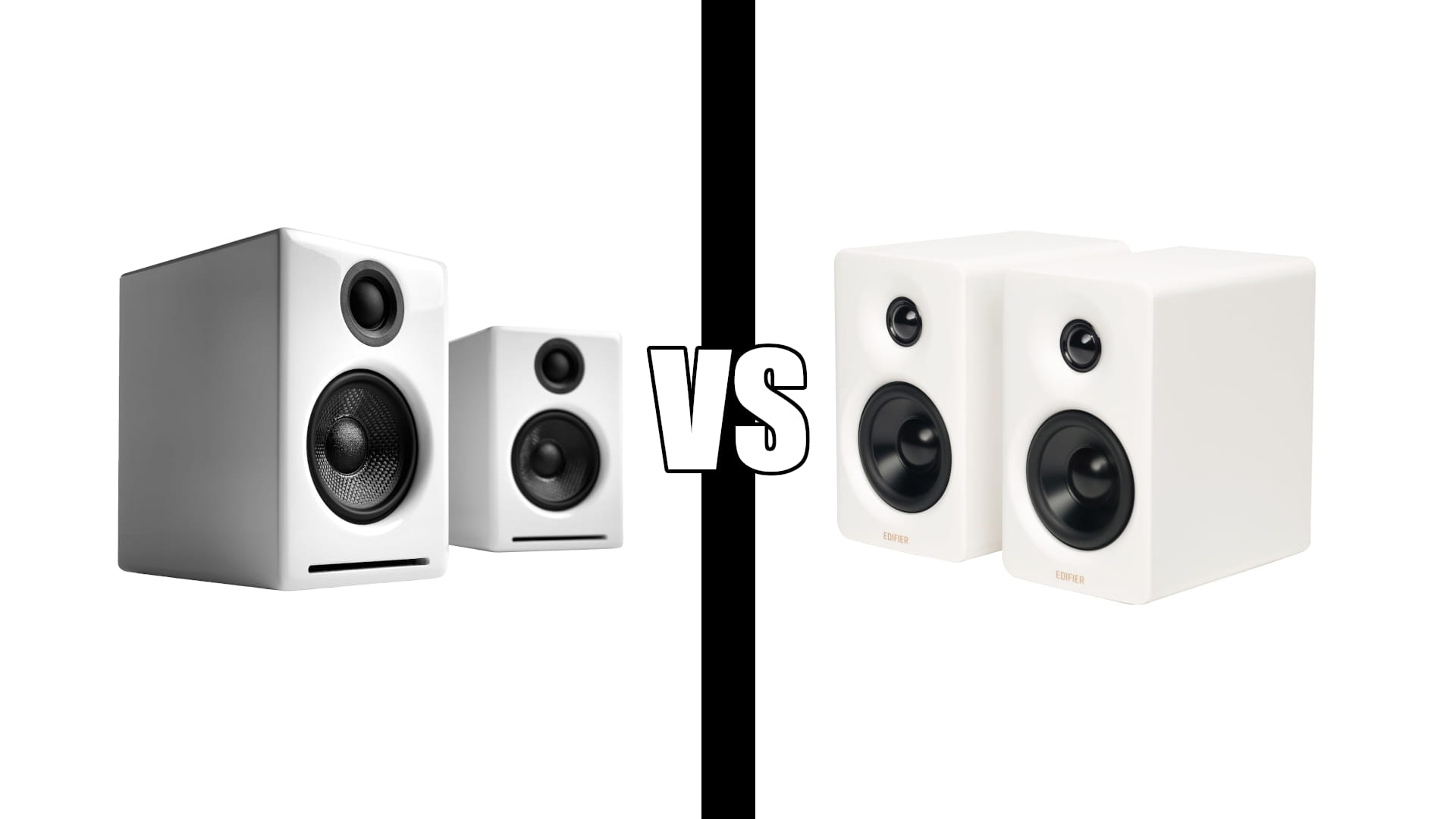
Audioengine A2+ vs Edifier M60: Which to Buy (2026)
Category: Tech & Gear | Reading time: 10 min | Last updated: November 2026
Disclosure: This post contains affiliate links. If you buy through our links we may earn a small commission at no extra cost to you.
Audioengine A2+ vs Edifier M60. Start with the single fact that tells you most about these two companies. The Edifier M60 comes with a pair of aluminum stands set at a 15 degree angle, and Edifier’s listing explains why: they direct the sound at ear level when the speakers are on a desk. Audioengine sells its angled stands separately, and A2+ owners keep bringing it up.
The M60 also costs a third less, rates slightly higher, and publishes every specification the A2+ leaves off its listing. On paper this is not close.
And yet one owner who bought the M60 first went out and replaced it with the A2+, and his reason is the most useful thing in either set of reviews. The two speakers do not sound different because one is better. They sound different because one of them processes the signal and the other mostly does not.
Jump to a section
The short answer
Buy the Edifier M60. It costs a third less, it rates 4.5 across 2,256 reviews with a smaller share of unhappy buyers than the A2+, it is Amazon’s Choice, and it arrives with the angled stands that genuinely change how desk speakers sound. For most people putting speakers on a desk for the first time, this is the correct answer and it is not a close call on value.
Buy the Audioengine A2+ if you have heard both and prefer the flatter one, or if you want real wood cabinets, RCA inputs for a turntable, or a subwoofer output. It is the more neutral speaker and the more old-fashioned one, and the people who love it tend to be the people who were annoyed by something else first.
One thing that should change your mind about the M60: if you want your speakers more than about six feet apart, read the cable section before you buy. That is a real limitation and it affects the thing that most improves stereo sound.
Edifier M60 in detail

At 4.5 across 2,256 ratings with 76 percent at five stars and only 6 percent at one or two, this has the cleanest distribution of any desktop speaker in this price range. It carries Amazon’s Choice and moves more than 500 units a month.
Edifier publishes everything. Driver sizes, the split of the 66 watts between bass and treble, amplifier class, crossover type, cabinet dimensions to the millimeter. That transparency is not a sound quality claim, but it is a useful signal about who expects to be compared on numbers.
The review that most resembles your situation comes from someone who set up a dedicated home office and wanted speakers for meetings and listening rather than gaming.
“I WFH and just set up a dedicated home office. I wanted a speaker system that would satisfy my needs for meetings and listening to audio content. I had a pair of Pebble speakers in place that we’re doing what they do, I just wanted a bit more than they were able to provide. I was a bit skeptical about the name/credibility of Edifier. I had not heard of them, ever, until I began looking for a new speaker set. When they arrived I was taken back by their size and heft. They have a solid construction and feel good to the touch, almost velvety. There no rattles, shakes of shimmys. The sound. Excellent. These are not heavy bass producers. My M60s can produce a signal at 60hz. Anything below that does not register. Again, the dishes will not rattle in the cabinet, but the sound at the desk is immersive and pleasing to my ear.”
The 60Hz figure is the most useful number any owner of either speaker has given. That is roughly where the M60’s bass stops, which is below the fundamental of a bass guitar’s low notes but above where kick drums and synth bass actually live. In practice it means plenty of body for voices, music and film dialogue, and nothing in your chest. Neither of these speakers will give you that without a subwoofer, and the M60 does not offer a subwoofer output at all.
The three-star review is worth reading too, because it is the other side of the same coin.
“These speakers are the audio equivalent of a shrug. I expected stronger bass, higher volume, or at least something that would make me say ‘wow.’ Instead, I found myself saying, ‘Oh… that’s it?’ They’re about 6″ deep, 6″ tall, and 4″ wide, so it’s not like they’re microscopic desktop speakers, but they are not large either. The real fun starts if you want to place the speakers more than 6 feet apart. The included cable is short, and finding a replacement that actually works feels like solving a puzzle Edifier forgot to include the instructions for.”
Who it’s for. Almost anyone setting up desk speakers who does not already have strong opinions about sound. It is the better value, it solves the placement problem in the box, and it has the broader appeal of the two.
Audioengine A2+ in detail

The A2+ has more reviews, 3,086, because it has been on sale far longer. It rates a notch lower at 4.4, with 74 percent five stars against the M60’s 76, and a slightly larger unhappy tail at 9 percent against 6.
What it offers that the M60 does not: real wood cabinets rather than an unstated material, RCA inputs so a turntable with a built-in preamp plugs straight in, a line output for a subwoofer, five colors instead of three, and a stated three-year warranty.
And the single most valuable review across both products is the one from someone who owned the M60 first.
“First I bought the Edifier M60 having never tried the Audioengine A2+. I used the Edifier M60 for a while but what kept bothering me was the way the M60 sounded so deviant from how things normally sound. It was an artificial sound and the music overpowered the vocals which were muddled at a low listening volume, so I couldn’t even listen to songs quietly, not if I wanted to actually understand the lyrics. Okay this review is for the Audioengine A2+. The vocals are very clear and pronounced. Because I am able to compare the two, I would never recommend anyone to buy the Edifier M60. I listened to music, watched anime and a nature documentary and everything was good. Everything sounds normal, which is good and also it can get very loud as well. Last of all, I recommend buying the angled speaker stands because it’s not a scam. It does actually sound much better when the sound is angled to hit your ears.”
Two things in there matter enormously. “Everything sounds normal, which is good” is the whole case for the A2+ in six words. And he independently arrives at the stands recommendation, which Edifier simply includes.
The A2+ also attracts the opposite complaint. A three-star owner running them in a small office through a dedicated sound card described the sound as dull and the bass as underwhelming, rated the sound itself lower than the product overall, and noted that angled stands should have been in the box given what Audioengine charges. He gave credit for the packaging, the connection options and the warranty.
So one owner calls the A2+ normal and praises it, and another calls it dull and marks it down. Those are the same observation with different expectations attached, and the next section is about why.
Who it’s for. People who already know they prefer a flatter speaker, people with a turntable, people who want a subwoofer later, and anyone who cares that the cabinet is real wood. Not the default pick.
The stands tell you everything
A speaker sitting flat on a desk fires horizontally, which puts the tweeter somewhere around your chest. Treble is directional in a way bass is not, so a tweeter aimed below your head genuinely sounds duller than the same speaker aimed at it. This is the most common reason desk speakers disappoint people, and it has nothing to do with the speakers.
Universal Audio’s guide to studio monitor placement sets out the principle: aim for the tweeter to reach ear level, tilt the speaker if it does not, and turn the pair inward so your head and the two speakers form roughly an equilateral triangle.
Edifier put that in the box. The M60 ships with aluminum stands at a fixed 15 degree angle, and the listing says in plain language that they reduce distortion by directing audio to ear level on a desktop. Someone at Edifier read the same advice and decided not to make it the customer’s problem.
Audioengine sells them separately, and its own customers notice. One five-star owner volunteers that the stands are worth buying and are not a scam. One three-star owner complains they should have been included and points out that Audioengine selling them proves the company knows they help. Those are two people arriving at the same conclusion from opposite ends of the rating scale.
This is not a reason to rule out the A2+. It is a reason to add stands to the basket if you buy it, and to understand that part of the A2+’s price gap over the M60 is a thing the M60 already includes.
If you would rather spend nothing, a pair of wedges or anything solid under the front edge does the same job. And before you buy anything at all, pull whatever speakers you own apart until the gap between them roughly matches the distance to your chair, then angle them inward. That costs nothing and it is the biggest single improvement available.
Specs side by side – Audioengine A2+ vs Edifier M60
| Audioengine A2+ | Edifier M60 | |
|---|---|---|
| Rating | 4.4 / 3,086 | 4.5 / 2,256 |
| Five-star share | 74% | 76% |
| One and two star share | 9% | 6% |
| Bought last month | Not stated | 500+ |
| Power | Not stated on listing | 66W RMS, 36W bass and 30W treble |
| Tweeter | Not stated on listing | 1 inch silk dome |
| Mid-bass driver | Not stated on listing | 3 inch aluminum long-throw |
| Amplifier | Built in, class not stated | Closed-loop Class-D |
| DSP | Not mentioned | Yes, with dynamic range control |
| Crossover | Not stated on listing | Two-way active |
| Size per speaker | Not stated on listing | 3.9 x 6.6 x 5.8 inches |
| Cabinet | Hand-finished real wood | Not stated on listing |
| Bluetooth | 5.4 with aptX-HD | 5.3 with LDAC |
| USB-C | Yes, with 24-bit DAC | Yes |
| RCA input | Yes | No |
| 3.5mm input | Yes | Yes |
| Subwoofer output | Yes, line out | Not stated on listing |
| Controls | Knob on rear | Touch panel on top, plus app |
| Angled stands | Sold separately | Included, 15 degrees |
| Colors | Five | Three |
| Warranty | 3 years | Not stated on listing |
Count the “not stated” rows. Audioengine publishes almost no measurements for the A2+ and Edifier publishes all of them. That is a genuine difference in how the two companies ask to be judged.
Why they sound different
Here is the part worth understanding before you spend anything, because it explains every contradictory review on both listings.
The M60 processes the signal. The A2+ does not say that it does. Edifier’s listing describes full digital processing, a two-way active crossover and dynamic range control from a built-in DSP. Audioengine’s listing mentions custom-tuned drivers and a DAC and says nothing about processing the sound after that.
Processing is how a four-inch-wide speaker sounds bigger than it has any right to. The DSP can lift the bass where the cabinet cannot, tame the peaks, and hold the overall level steady. It is also why people describe the M60 as sounding “bigger than they are” within ten minutes of unboxing. That reaction is engineered and it is not dishonest.
But dynamic range control has a cost, and one owner describes it precisely. His complaint about the M60 was that music overpowered the vocals and the vocals muddled at low volume, so he could not listen quietly and follow lyrics. That is consistent with heavy processing: when the system is boosting the ends of the spectrum and compressing the middle, the voice sits further back, and the effect is most obvious when you turn it down.
I want to be careful here. One owner’s description is not a measurement, and I have not tested either speaker. What I can say is that the mechanism he describes matches the feature Edifier advertises, and that the A2+ owner who switched used the word “normal” as praise while the A2+ owner who disliked it used the word “dull” as criticism. Both were listening to the same flat-ish speaker.
The practical version. If you want speakers that impress you immediately and make small-format audio feel substantial, that is the M60 and most people want that. If you listen at low volume, care about hearing a voice clearly, or have ever found processed audio tiring over a long day, the A2+ is the safer one. Nobody can tell you which you are from the outside, including me, and both come with free returns.
Where the controls are
Both of these get something wrong here, in opposite directions.
The A2+ puts its volume knob on the back of the cabinet. Its most detailed reviewer calls that his primary complaint, noting that the placement keeps the left and right speakers looking identical but means reaching behind a speaker whenever your sources differ in level. If everything comes from one computer and you control volume in software, you will set it once and forget it. If you switch between a computer, a phone and something on the analog input, you will be reaching round the back for years.
The M60 puts a capacitive touch panel on top, with a backlight that wakes as your hand approaches, which sounds better than it works. Its five-star reviewer’s only gripe is the control experience: switching to Bluetooth on the speaker and then connecting through the ConneX app whenever he wants to use his phone to manage inputs and volume. The three-star reviewer references other owners finding the controls a challenge too.
So: a knob you cannot reach, or a touch surface and an app. The knob is more reliable and worse placed. The touch panel is better placed and more fiddly. Pick your annoyance.
The M60’s cable problem
This is the one thing that would make me buy the A2+ instead, and it is specific.
The M60’s included cable between the left and right speakers is short. One owner who wanted them more than about six feet apart went looking for a replacement and describes the result as a puzzle without instructions. He contacted Edifier support, was sent to another Edifier site, found a cable listed as compatible with several models but not the M60, and was then told by support that it would not work anyway and that they do not sell one that does. He eventually found something that works but does not fit tightly.
That matters more than it sounds, because speaker separation is the thing that most improves stereo sound. The placement advice above is to spread the speakers until the gap between them roughly matches the distance to your head. On a wide desk, or a desk with a large monitor or two, that can easily be more than six feet. If the cable will not reach, the M60 cannot do the one placement change that costs nothing.
The A2+ uses binding posts and ordinary speaker wire between its cabinets, which one owner specifically appreciates and notes you can upgrade with banana plugs. Longer wire is a trivial purchase.
So measure how far apart you want them. Under six feet, this is a non-issue. Over six feet, it is the deciding factor.
Bluetooth codecs, and why yours may not matter
Both listings make a point of their wireless audio quality and for a lot of buyers neither claim will apply.
The M60 runs Bluetooth 5.3 with LDAC, which Edifier states carries up to 990 kbps and 24-bit audio from Android devices running version 8.0 or later. That qualifier is in Edifier’s own bullet and it is the important part. The A2+ runs Bluetooth 5.4 with aptX-HD, which is Qualcomm’s codec and needs a device that supports it.
If you are on an iPhone, you will get neither. Apple devices do not support LDAC or aptX, so an iPhone falls back to AAC on both speakers and the two headline codec features become irrelevant. That is not a flaw in either product, but it does mean a chunk of buyers are comparing a specification that will never engage for them.
And on a desk, none of it is the point. Both speakers take USB-C from a computer sitting three feet away, and the A2+ puts a 24-bit DAC behind that input. A cable beats any codec, costs nothing, adds no latency, and latency is what you notice the moment you watch something with a picture.
Use Bluetooth for your phone. Use the cable for the computer. Then the codec argument stops being yours.
Which one to buy
| If you | Buy |
|---|---|
| Are not sure | Edifier M60 |
| Want the best value | M60, a third less with stands |
| Want speakers that impress immediately | M60 |
| Do not want to buy accessories | M60, the stands are in the box |
| Reach for the volume at the speaker | M60, but expect a touch panel |
| Want them more than six feet apart | A2+, the M60 cable will not reach |
| Listen quietly and want clear vocals | A2+ |
| Have a turntable | A2+, it has RCA inputs |
| Plan to add a subwoofer | A2+, it has the output |
| Want real wood cabinets | A2+ |
| Find processed audio tiring | A2+ |
Buy the M60. It is a third cheaper, it rates higher with fewer unhappy owners, it tells you what is inside it, and it solves the desk angle problem in the box rather than selling you the solution afterward. For most people buying desk speakers that is the end of the question.
Buy the A2+ if your desk is wide enough that the M60’s cable becomes a problem, if you want RCA or a subwoofer output, or if you already know you prefer a speaker that does not flatter the music. It is the more neutral and more traditional of the two, and the owner who tried both and switched is not wrong about what he heard. He is just describing a preference rather than a defect.
If you are also weighing Audioengine’s bigger model, that is a different question about desk space rather than sound, and we covered it in Audioengine A2+ vs A5+.
If neither of these is the shape you want on your desk, we put both against three cheaper options in the best desktop speakers for a home office.
Frequently asked questions
Is the Edifier M60 better than the Audioengine A2+?
Better value, certainly. It costs a third less, rates 4.5 against 4.4, has a smaller share of one and two star reviews, publishes all its specifications, and includes the angled stands Audioengine sells separately. Whether it sounds better is a preference: the M60 processes the signal to sound bigger, and at least one owner found that artificial enough to switch to the A2+.
Why does the M60 sound bigger than it looks?
Digital signal processing. Edifier states that the M60 uses full digital processing with a two-way active crossover and dynamic range control, which is how a four inch wide cabinet produces more apparent bass and a steadier level than its drivers alone would manage. It is a real engineering achievement and it is also why the sound is not neutral.
Do the Edifier M60 come with speaker stands?
Yes, a pair of aluminum stands angled at 15 degrees, included in the box. Edifier’s own description says they direct the audio to ear level on a desktop, which is the correct reason to use them. Audioengine sells equivalent stands for the A2+ separately.
How far apart can the Edifier M60 go?
Roughly six feet on the included cable. One owner who wanted more found no official longer replacement, and Edifier support confirmed they do not sell one that works. If you have a wide desk or two large monitors, check your intended spacing before buying, because speaker separation is the single biggest free improvement to stereo sound.
How much bass do these have?
One M60 owner reports useful output down to about 60Hz and nothing below. That is enough for voices, most music and film dialogue, and not enough for anything you feel. A2+ owners make similar observations and some add Audioengine’s subwoofer through the line output, which the M60’s listing does not offer.
Does LDAC or aptX-HD matter?
Only if your device supports them. Edifier states LDAC works at full quality from Android 8.0 or later. aptX-HD on the A2+ needs a compatible device too. iPhones support neither, so they fall back to AAC on both speakers. On a desk the better answer is the USB-C cable, which beats any codec and adds no latency.
Which has better connectivity?
The A2+, if you need RCA. Both have USB-C and 3.5mm, but only the A2+ takes RCA, which matters for a turntable with a built-in preamp, and only the A2+ has a subwoofer output. The M60 counters with app control and a touch panel you can actually reach.
Can I use either for video calls?
Not well. Any speaker on your desk gets picked up by your microphone and sent back to the other person as an echo. Keep the speakers for the rest of the day and wear something over your ears for the calls.
Continue reading
Driver sizes, wattage, processing and codec claims are the manufacturers’ own published figures, and the A2+ listing does not state power, driver sizes or cabinet dimensions. The comparison of how the two sound rests on owner descriptions rather than measurement, and is labeled as such where it appears. Placement guidance is drawn from Universal Audio’s studio monitor placement guide, linked above. Specifications taken from current manufacturer listings and verified buyer reviews. Prices change often, so check at checkout. Last updated November 2026.