Audioengine A2+ vs A5+: Which One for Your Desk (2026)
Category: Tech & Gear | Reading time: 14 min | Last updated: November 2026
Disclosure: This post contains affiliate links. If you buy through our links we may earn a small commission at no extra cost to you.
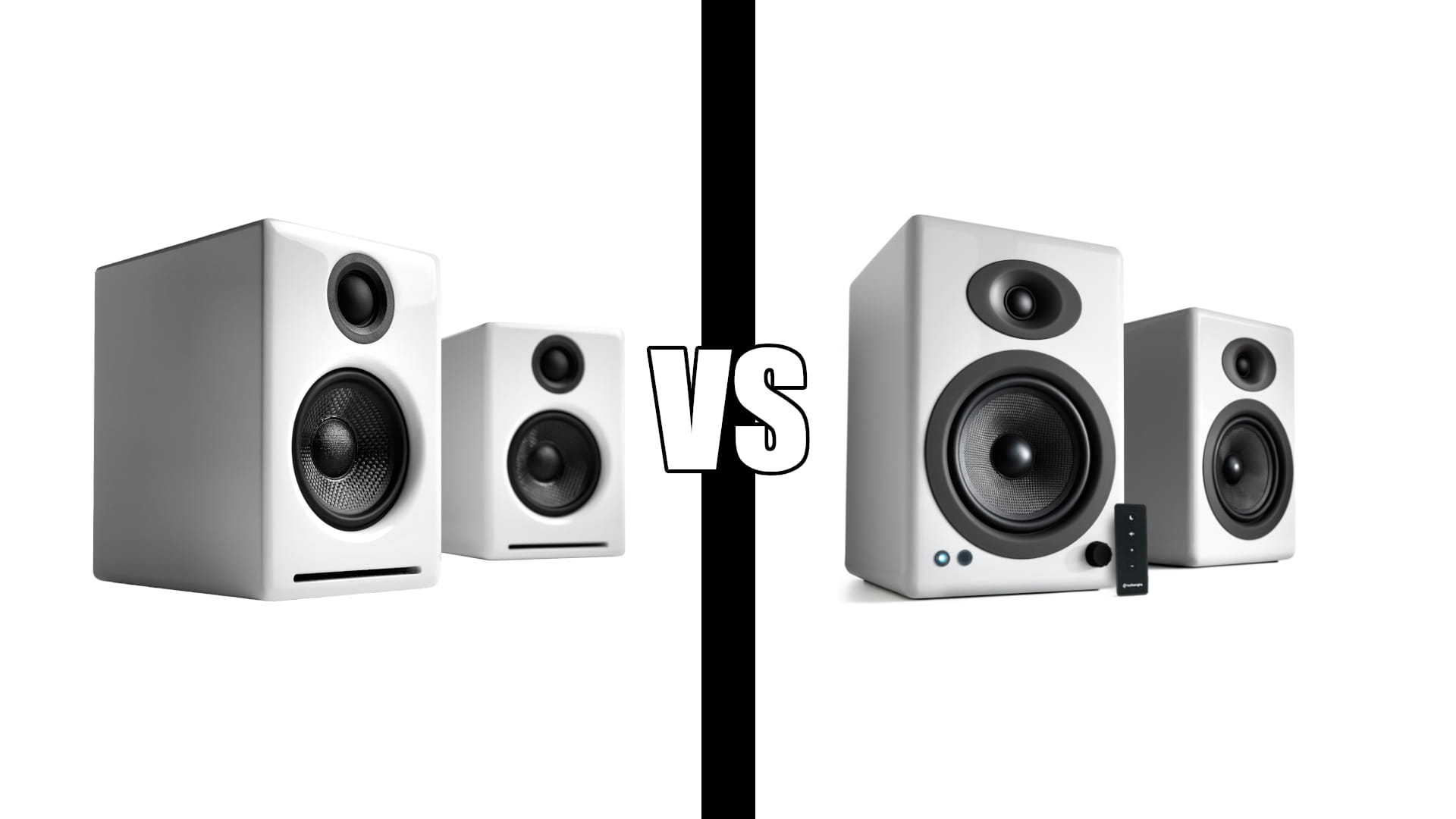
Audioengine A2+ vs A5+. Audioengine’s own marketing answers this question and almost nobody notices. The A2+ is sold as computer speakers, engineered for nearfield listening on desks. The A5+ is sold as bookshelf speakers for turntables, vinyl and home theater, described as filling a room.
So this is not really a comparison of a small speaker and a big speaker from the same family. It is a desk speaker against a room speaker that a lot of people put on a desk anyway. Both rate 4.4, both have the same 74 percent five-star share, and the difference between them is not quality.
Two things follow from that, and neither appears in any other comparison of these two. The volume knob is in the wrong place on one of them, and it is not the one you would guess. And whichever you buy, you will need to solve a problem Audioengine sells the fix for separately.
If the Audioengine is only on your list because it came up first, it’s worth knowing the Edifier M60 undercuts it and includes the stands Audioengine charges for.
Jump to a section
The short answer
Buy the A2+ if you have a normal desk. It is the one Audioengine built for this job, it costs less, and it has 3,086 reviews behind it at 4.4 with three quarters of them at five stars. It is compact enough to sit either side of a monitor without crowding you, and it comes in five colors if that matters.
Buy the A5+ if your desk is deep, or if you want the speakers to serve the room as well as the chair. It is a genuinely bigger speaker with 150 watts behind it, the volume knob is on the front where you can reach it, and one owner reports a pair still running after fourteen years. It is also furniture, and it will look like furniture on your desk.
Whichever you buy, budget for angled stands, and do not plan on using them for video calls. Those two sentences will matter more day to day than anything in the spec sheet, and the rest of this explains why.
What Audioengine actually sells
This trips people up before they get anywhere near a buying decision, so it is worth two minutes.
The A2+ is also called the A2 Gen 3. The Amazon listing title says A2 Gen 3 Wireless and the very first bullet underneath it says “WHY CUSTOMERS CHOOSE A2+”. Same speaker, two names, on the same page. If you have been comparing an A2+ review against an A2 Gen 3 review and wondering which one you want, the answer is that they are the same thing.
The A5+ listing is three different products. Under Style you get Wired, A5 Bluetooth and HD5 Bluetooth, and those are not three versions of one speaker. The HD5 is from Audioengine’s separate HD line. It sits between the other two on price and it has 25 reviews against the wired A5+’s 1,283, which tells you how many people pick it.
That variant split matters for reading reviews too. The ratings are pooled across all three, so a complaint about Bluetooth dropouts came from someone who did not buy the wired version, and praise for plug-and-play simplicity may have come from someone who did.
Check which style is selected before you add anything to a cart. It is easy to land on the wrong one.
Audioengine A2+ in detail

With 3,086 ratings this has the deepest evidence base of anything in the category, and the distribution is healthy: 74 percent at five stars and only 9 percent at one or two. The things people praise are consistent. Real wood rather than plastic, vocals that stay clear at low volume, and packaging that borders on excessive in a good way.
The most thorough review on the listing comes from someone who clearly knows audio, gave it four stars, and spent several paragraphs explaining both sides.
“I’ve wanted these for a number of years as they’re aesthetically pleasing and are an excellent option for environments where speaker placement options are very limited. The front-facing port helps with minimizing the amount of space required between the back of the speaker and a wall. The A2+ gets plenty loud for small to medium sized rooms. They have a slightly bright signature which isn’t overbearing; I haven’t experienced any listening fatigue over hundreds of hours of media consumption. In 2026, it’s harder to justify these as being the de facto answer for many people based on price. If space constraints don’t exist for your intended application, it’s possible to get an equivalent or superior experience at a lower cost. Going slightly larger also presents products which have volume and/or tone controls either on the front of the speaker or the side of the speaker. This was the primary issue I had; the volume control on the back of the speaker allows for a visually consistent appearance, but may be problematic to continuously adjust if your sources vary in level.”
Read that carefully, because he is quietly making the case for the A5+. His argument is that the A2+ earns its keep when space is tight and becomes harder to justify when it is not, and that going slightly larger gets you a volume control you can actually reach. That is the whole comparison, written by somebody who owns the smaller one.
Bass is the other recurring note. There is a limit to what a woofer this size can do, and owners who want low end add Audioengine’s subwoofer through the line output. A three-star owner running them in a small office described the sound as dull and the bass as underwhelming, and rated the sound itself lower than the product overall, giving credit to the packaging, the connection options and the warranty.
Worth putting that in context. One owner who had used an Edifier M60 first described the M60 as artificial, with music overpowering muddled vocals at low volume, and switched to these specifically to fix it. Preferences in this category are genuinely personal and both of those people are describing the same speakers.
Who it’s for. Anyone with a standard desk who wants real speakers rather than a soundbar or a plastic 2.1 set. Also anyone whose desk is pushed against a wall, since the front-facing port means they tolerate being close to it.
Audioengine A5+ in detail

Audioengine sells these for turntables, vinyl, music streaming and home theater. Computer use is not in the headline. That framing is the most honest thing on either product page and you should take it at face value.
The rating is identical to the A2+, 4.4 with 74 percent at five stars, across 1,283 reviews of the wired version. So this is not a question of one being better made.
The most informative five-star review describes exactly the environment these are built for, which is not a desk.
“These are the backbone of my family room setup. The solid bamboo cabinets look fantastic against the old brick and the antique cabinet. Under the hood they’re legit: 5″ aramid fiber woofers, silk dome tweeters, and a Class AB amp in the left speaker putting out 50W RMS per channel. They fill the room with clean, punchy sound that’s way bigger than the boxes. Front-panel volume knob, RCA and 3.5mm inputs. Simple. The A5+ sub out feeds a wireless transmitter that beams the low end across the room to a sub. No sub cable snaking across the floor, and because the output is variable, the A5+ volume knob runs the sub right along with the mains. If you want powered speakers that look like furniture, sound bigger than they appear, and play nice with a sub, these are a no-brainer.”
“Powered speakers that look like furniture” is the right description, and it is also the warning. He has them in a family room on a pair of vintage milk cans. That is the use case.
On longevity, the best data point on either listing is a four-star review. The owner bought his fourteen years ago and they still work, with the volume knob becoming erratic somewhere around year five or six. He routes volume through his streamer instead and carries on. Fourteen years of service with one annoying fault is a strong result for powered speakers, and it is the sort of thing a three-year warranty does not tell you.
The failure worth knowing about is in the three-star reviews.
“They sound amazing, until they don’t. I went through two sets, both developed a high pitch intermittent whine coming from the tweeter within a few days. Happened regardless of where they were plugged in and when not connected to any audio source.”
Two sets in a row with the same fault is unlucky rather than typical, given 1,283 reviews averaging 4.4. But it is a specific, recognizable symptom, it appeared within days both times, and it happened with nothing plugged into them, which rules out a ground loop from a computer. If yours whines, that is a return rather than something to troubleshoot.
Who it’s for. Deep desks, or desks in rooms where you also listen away from the chair. Turntables. Anyone who would rather buy one pair of speakers that works at a desk and in a living room than two pairs that each work in one.
Audioengine A2+ vs A5+ – Specs side by side
| Audioengine A2+ | Audioengine A5+ Wired | |
|---|---|---|
| Rating | 4.4 / 3,086 | 4.4 / 1,283 |
| Five-star share | 74% | 74% |
| One and two star share | 9% | 10% |
| Sold as | Computer speakers | Bookshelf speakers |
| Designed for | Nearfield desk listening | Filling a room |
| Power | Not stated on listing | 150 watts, 50W RMS per channel |
| Drivers | Not stated on listing | 5 inch aramid woofer, silk dome tweeter |
| Volume knob | Rear of speaker | Front panel |
| Bluetooth | Yes, 5.4 with aptX-HD | No on this variant |
| USB-C with DAC | Yes, 24-bit | No |
| Analog inputs | RCA and 3.5mm | RCA and 3.5mm |
| Subwoofer output | Line out | Variable, knob controls it |
| Port | Front-facing | Not stated on listing |
| Cabinet | Hand-finished real wood | 13-step gloss or bamboo |
| Colors | Five | Three |
| Warranty | 3 years | 3 years |
Audioengine publishes driver sizes and wattage for the A5+ and not for the A2+, which is itself a hint about which one they expect you to compare on numbers.
How much desk do you actually have
This is the decision, and it is a measuring problem rather than an audio one.
The A2+ is designed to sit on a desk beside a monitor and leave you room to work. The A5+ is a bookshelf speaker, and bookshelf is a real category rather than a marketing word: it means a cabinet big enough that it normally lives on a shelf or a stand rather than a work surface. Put a pair either side of a monitor on a standard depth desk and you will have bought yourself a smaller desk.
Measure the space between your monitor and the edge of your desk before you decide anything else. If you are working on a 24 inch deep surface with a monitor arm already claiming the back edge, the answer is the A2+ and the rest of this post is academic.
There is a second consideration that favors the A5+ for some people. If your desk is in a living room, a bedroom or a studio apartment, a pair of A5+ can do the work of desk speakers and room speakers at once. You listen at the desk during the day and from the sofa in the evening. That is a genuinely good reason to buy the bigger ones, and it is a better reason than wanting them to sound louder.
If your desk is pushed against a wall, the A2+ has one real advantage: its port fires forward rather than backward, so it tolerates sitting close to a wall without the boomy low end you would otherwise get. Owners specifically mention it.
Where the volume knob is
Here is the detail that surprised me, and it runs backwards from what you would expect.
The A2+, the desk speaker, has its volume knob on the back. The A5+, the room speaker, has its volume knob on the front panel.
Think about what that means in practice. The speakers you sit twenty inches from make you reach around behind them to change the level. The speakers you might sit across a room from put the control where you can see it. Audioengine’s reasoning is presumably visual symmetry, since a knob on the front of only the left speaker breaks the matching look, and the A2+’s most detailed reviewer says exactly that and still calls it his primary complaint.
How much this matters depends entirely on whether your sources vary in level. If everything you play comes from one computer and you control volume in software, you will set the knob once and never touch it. If you switch between a computer, a phone over Bluetooth and something plugged into the analog input, each at a different level, you will be reaching behind a speaker several times a day for years.
That is the kind of thing nobody discovers until the speakers are on the desk, which is why it is worth a section.
The angle nobody tells you about
Two separate A2+ owners raised the same point from opposite directions, which is usually the sign of something real.
One, a five-star reviewer, finished by recommending angled speaker stands, saying plainly that it is not a scam and that it does sound much better when the sound is angled to hit your ears. Another, a three-star reviewer unhappy with the sound, complained that stands should have been included at this price and noted that Audioengine sells them separately, so the company clearly knows they improve things.
They are both describing the same physics. A speaker sitting flat on a desk fires horizontally, which puts the tweeter somewhere around your chest. Universal Audio’s guide to studio monitor placement covers the principle: aim for your listening position and the two speakers to form an equilateral triangle, turn the speakers inward at roughly 30 degrees toward your ears, and tilt them so the tweeter points at ear level rather than past it.
None of that happens by itself when a speaker is sitting flat beside a monitor. Treble is directional in a way bass is not, so a tweeter aimed at your sternum genuinely sounds duller than the same speaker aimed at your head. Some of the complaints about these speakers sounding flat are almost certainly a placement problem being blamed on the hardware.
What to do about it. Angled stands are the clean fix and Audioengine makes them. A pair of small wedges or even something solid under the front edge does the same job for nothing. And before you spend anything, pull the speakers apart so they are roughly as far from each other as they are from you, and turn them in toward your chair. That costs nothing and it is the single biggest improvement most people can make.
Speakers, Bluetooth and video calls
One warning before you set these up as your main audio for a working day.
Desk speakers and video calls do not mix. The other person’s voice comes out of your speakers, your microphone picks it up, and the call sends it back to them with a delay. They hear themselves. Echo cancellation catches some of it and struggles exactly when both people are talking. If you take calls all day, these are for the hours around the calls, and you want something over your ears for the calls themselves.
And on the Bluetooth question, the buyers have already answered it. The A5+ listing offers wired, Bluetooth and HD5 Bluetooth variants, and the review counts split 1,283 for wired against 687 for Bluetooth and 25 for the HD5. Roughly two thirds of A5+ buyers deliberately skip wireless.
That makes sense for a speaker sitting three feet from a computer. Bluetooth costs more, adds a pairing step, and introduces latency that shows up the moment you watch anything with a picture, which is most of what people do at a desk. A cable solves all three.
The A2+ includes Bluetooth 5.4 with aptX-HD as standard, so you are not paying extra for it there and you can simply not use it. On the A5+ you are choosing, and most people choose the cable.
Which one to buy
| If you | Buy |
|---|---|
| Are not sure | A2+ |
| Have a standard depth desk | A2+ |
| Have a desk against a wall | A2+, the port fires forward |
| Want to connect over USB-C | A2+, it has the DAC |
| Want Bluetooth | A2+, it is standard |
| Have a deep desk or a wide one | A5+ |
| Want the speakers to serve the room too | A5+ |
| Have a turntable | A5+, that is what it is sold for |
| Adjust volume at the speaker often | A5+, the knob is on the front |
| Plan to add a subwoofer | A5+, one knob controls both |
| Want the most color options | A2+, five of them |
Most people reading this should buy the A2+. It is the one designed for the job, it costs less, it has more than twice the reviews, and the thing it gives up is power you probably do not need twenty inches from your face.
Buy the A5+ when your desk is big enough that a bookshelf speaker is not an imposition, or when the room matters as much as the chair. Just go in understanding that you are buying a room speaker and putting it on a desk, not buying a better desk speaker. Audioengine has been clear about that from the start and it is the rest of the internet that muddled it.
And whichever you choose, spend a few minutes on placement before you decide what they sound like.
Both of these sit near the top of our desktop speaker roundup, alongside two cheaper sets worth knowing about if neither of these is your price.
Frequently asked questions
Is the Audioengine A2+ the same as the A2 Gen 3?
Yes. The Amazon listing title calls it the A2 Gen 3 Wireless and the bullets underneath call it the A2+. Same speaker, two names, on the same page.
Is the A5+ too big for a desk?
It depends entirely on your desk, and the honest answer is that it is a bookshelf speaker rather than a desk speaker. Audioengine sells it for turntables, vinyl and home theater. On a standard depth desk with a monitor it will take up real working space. Measure between your monitor and the front edge first.
Does the A5+ have Bluetooth?
Only if you choose the Bluetooth variant. The listing sells wired, A5 Bluetooth and HD5 Bluetooth versions under one page, and the wired one has no Bluetooth by design. About two thirds of buyers pick wired, which makes sense for a speaker sitting a few feet from a computer.
What is the HD5 and should I get it?
It is from Audioengine’s separate HD line, offered as a third option on the A5+ listing, priced between the wired and Bluetooth A5+. It has 25 reviews against the wired A5+’s 1,283, which is too thin a base to recommend from. Not a reason to avoid it, just a reason not to buy it on the strength of reviews that barely exist yet.
Do I need speaker stands?
You need the speakers angled up at your ears, and stands are the tidiest way to do it. A speaker sitting flat on a desk aims its tweeter at your chest, and treble is directional enough that this genuinely dulls the sound. Two separate A2+ owners raised it independently. Wedges or anything solid under the front edge works too.
Can I use these for video calls?
You can, but the people you call will hear themselves echo back, because your microphone picks up your speakers. Use headphones or a headset for calls and the speakers for everything else.
How long do these last?
One A5+ owner reports a pair bought fourteen years ago still working, with the volume knob becoming erratic around year five or six. Both models carry a three-year warranty. The failure worth watching for on the A5+ is an intermittent high pitched whine from the tweeter, which one owner hit on two sets within days of unboxing. That is a return, not a repair.
Do I need a subwoofer?
Not necessarily, but both have outputs for one and A2+ owners mention wanting it more often, which is what you would expect from the smaller woofer. The A5+’s subwoofer output is variable, so its front volume knob controls the sub along with the speakers, which is a small convenience that matters daily.
Continue reading
Driver sizes, wattage and connectivity are Audioengine’s own published figures, and the A2+ listing does not state power or driver size. Review counts are per variant where the listing splits them, which is noted where it matters. Placement guidance is drawn from Universal Audio’s studio monitor placement guide, linked above. Specifications taken from current manufacturer listings and verified buyer reviews. Prices change often, so check at checkout. Last updated November 2026.