CyberPower vs APC: Which UPS for a Home Office (2026)
Category: Tech & Gear | Reading time: 15 min | Last updated: November 2026
Disclosure: This post contains affiliate links. If you buy through our links we may earn a small commission at no extra cost to you.
CyberPower vs APC. CyberPower and APC are the two brands you will actually be choosing between, and almost every comparison of them is a spec table with a coin flip at the end. Here is the thing those comparisons miss.
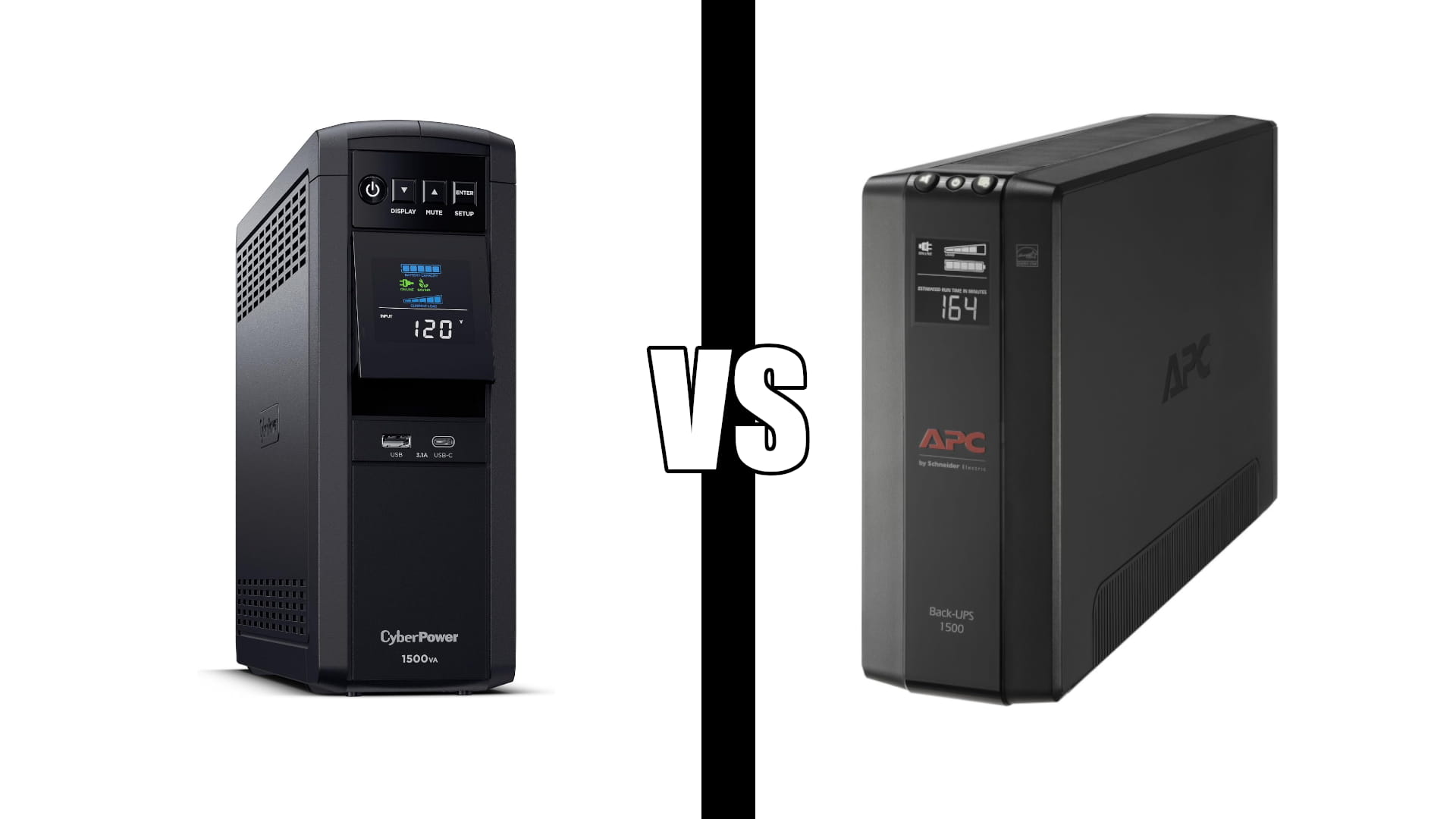
APC sells two 1500VA units for a home office, and they sit either side of CyberPower’s. The cheaper APC outputs a stepped approximation of mains power. The pricier one outputs a pure sine wave, and APC charges a hefty premium for it. CyberPower’s unit sits between the two on price and already gives you the pure sine wave.
Which means the technical argument everyone has about sine waves is one you can simply opt out of. And you should, because as you will see below, APC’s own marketing materials cannot keep their story straight on it.
Jump to a section
CyberPower vs APC – The short answer
Buy the CyberPower CP1500PFCLCD. It gives you pure sine wave output for roughly 20 percent less than APC charges for the same thing, and it beats both APC units on watts, outlets and USB charging while matching them on rating. Ten thousand people a month buy it. It is the best value in this comparison and it is not close.
Buy the APC BX1500M if you want to spend as little as possible and you are powering a router, a modem, a NAS or a laptop dock rather than a desktop PC. It is the cheapest way to stop losing your network every time the lights flicker, it has the largest review base here at 13,100, and it adds coax and Ethernet surge protection the CyberPower does not mention.
Buy the APC BR1500MS2 only if you specifically want APC’s pure sine wave unit. It is the most expensive of the three and sells a tenth as many units as the CyberPower. It is a good UPS. You are paying a brand premium for an output the CyberPower already has.
CyberPower CP1500PFCLCD in detail

Start with the numbers, because this is where the comparison is decided. The CyberPower delivers 1000W against 900W from both APC units, so it carries more load at the same 1500VA rating. It has twelve outlets against APC’s ten, and six of those are on battery backup against five on the cheaper APC. It has two USB charging ports including a USB-C, and the cheaper APC has none.
The warranty is the part worth reading twice. Three years including the battery, which is the component that actually wears out. Lead acid batteries in these units last around four years, so a warranty that covers the battery for three of them is a meaningful difference rather than paperwork.
At 4.5 across 11,545 ratings with 81 percent at five stars, it also has the best distribution on this page. Only 8 percent of reviewers land at one or two stars.
Owners who bought it twice are the strongest signal on any product, and this one explains what he actually gets out of it.
“So good, I bought 2! UPS systems in this class can easily cost more. I have had poor experience with APC systems in this range, so I gave CyberPower a shot. First one I bought for all my network equipment. I have a couple routers attached, several WiFi Mesh base units attached by PoE router, laptop, NAS and a couple other items. I get 1 hour or more of uptime! All the items I have attached amount to about 40% load if they are all on at the time. The 2nd UPS I bought about a year later for my home entertainment stuff, TV, stereo and a couple miscellaneous network items. Also gets about 1 hour uptime. We live in the mountains and power can be flaky. When I get a power out notification I know I have about 1 hour of uptime before I need to turn on the generator.”
Two things worth extracting. He came to CyberPower specifically because APC had disappointed him, which is the mirror image of the review you will read in the reliability section below. And he gives the most useful runtime figure available: network gear at roughly 40 percent load buys him an hour or more.
He also bought the optional network card so he could monitor utility power from work, which is worth knowing exists if you have a cabin, a rental or a rack you are not sitting next to.
The most useful critical review comes from someone running a business from home, on his third CyberPower unit, who gives it four stars for one specific reason.
“I’ve had really good luck with the longevity of 2 other CyberPower UPS that I purchased on Amazon in the past. One of them has been connected to my home office setup since I run a business out of my home and it’s important to stay connected no matter what. I’ve got my internet and computer system fully on the UPS backup and I lost count how many times power went out and I didn’t skip a beat. I wanted to really like this unit but now that I upgraded my home system, I can no longer run a self-test on my Mac. The software is outdated and the previous version that was loaded was useless so I went to the CyberPower website hoping to find an updated version but after downloading the one that’s there, it’s a version that’s made for business IT people, not for personal monitoring of battery health. I got 4 years and 4 months out of the last battery which I just replaced myself. Our power went out on Thursday morning and it just came back on today (Sunday late afternoon). The UPS worked flawlessly. One star deducted due to the wonky software situation.”
The software is the real complaint and you should expect it. PowerPanel comes in a personal edition and a business edition, and this owner found the consumer version he had relied on gone, replaced by something built for IT departments. A second Mac owner reviewing seven months earlier was still using PowerPanel Personal, so something appears to have changed during 2026. Either way, if you are on a Mac and want to monitor battery health from the desktop, expect friction.
The other thing he confirms is battery life. Four years and four months on the previous unit, replaced himself, with a battery store manager telling him that is normal for lead acid. Plan on replacing the battery around year four on any UPS in this class, from either brand.
If you are a Mac owner buying this for automatic shutdown, read this before you order. A Mac Studio owner spent a long review documenting what does and does not work, and found a limitation that applies no matter which software you use.
“I purchased this CyberPower Sinewave UPS primarily for my Mac Studio setup, with the expectation that it would also communicate with macOS via USB to monitor and automatically shut the computer down. The hardware itself performs as expected. During a recent power outage, the unit kept all connected devices running without interruption. Where things become less consistent is on the software side. Neither PowerPanel Personal nor macOS can reliably communicate with the UPS when the computer is in sleep mode. The computer must remain awake for automatic shutdown to function properly. Unless the Mac is awake, the UPS will not automatically shut it down when the battery gets low.”
That sleep limitation is the important one and he is clear that it is macOS behavior rather than CyberPower’s fault: USB communication is not maintained while the Mac sleeps, so nothing can tell it to shut down. If the point of your UPS is that your machine saves itself while you are out, you will need to stop the Mac sleeping on battery power, which means a settings change or a third-party app to keep it awake. He also had to uninstall and reinstall the software to restore communication after an outage, which he notes would be a site visit rather than an inconvenience if you managed this for a client.
None of that touches the hardware. Both Mac owners say the unit did its actual job through real outages. It is the monitoring layer that is unreliable, and it is worth knowing which half you are buying.
Who it’s for. Anyone with a desktop PC, a gaming rig, a NAS, or a workstation they care about. Also anyone who just wants the most capable unit of the three, because on specifications that is what this is.
APC BX1500M in detail

This is the one APC sells in volume, six thousand a month, and with 13,100 ratings it has the largest body of owner feedback anywhere in this comparison. At 4.4 with 77 percent five stars it is a well-liked product.
It also has two things neither other unit advertises. Coaxial and Ethernet surge protection is built in, which matters if lightning can reach your cable line. And it is ENERGY STAR certified at over 92 percent efficiency, which on a device that runs every hour of every year is not nothing.
The most complete owner review explains exactly what this unit is good at, and it is not desktop PCs.
“We had a couple outages this year and I got tired of my router and modem dropping every time. When the power cut out, this thing switched over instantly. My router and modem never even blinked. The LCD screen shows load and runtime. Ten outlets is a lot. I’ve got my modem, router, NAS box and a couple lamps all running off it with room to spare. Our voltage sags a lot in summer where I live, and I can watch this thing correct it on the display instead of draining the battery every time. It’s heavy in a way that tells you there’s a real battery in there. No likes: This thing is loud when its on battery. The fan and the beeping when the power drops is startling if your not expecting it. It’s a big unit. I had to rearrange my media cabinet to fit it, its wider and taller than I pictured. The battery is a separate buy down the road, and from what I can tell those replacement batteries aren’t cheap.”
Three practical things from that, all of which apply to the CyberPower too. These units are loud on battery, with a fan and an alarm that will startle you the first time. They are physically larger than product photos suggest, so measure the space before ordering. And the replacement battery is a separate purchase at year four or so, on top of the unit.
The one-star share is 9 percent, which is the highest of the three, and the three-star review on the listing is worth reading as a warning about age rather than about this unit specifically. An owner six years in replaced the battery and then found his PC crashing continuously with blue screens until he removed the UPS and went back to a plain surge strip. One report is one report, but an aging UPS with a fresh battery producing unstable power is a recognized failure pattern, and it is a reason not to nurse one of these past its useful life.
Who it’s for. Network gear, a laptop dock, a NAS, lamps, anything that just needs to not drop. If your goal is that your Wi-Fi survives a flicker and you never want to reset your modem again, this is the cheapest correct answer and you can stop here.
The APC that matches CyberPower on output

This unit is here because without it the comparison would be dishonest. Pitting a pure sine wave CyberPower against a stepped-output APC and declaring the CyberPower better on price would be comparing two different products. So here is the like-for-like version: APC’s pure sine wave answer, rated 4.5 across 3,500 ratings, adding USB-C charging and a sixth battery outlet over the BX1500M, and claiming the longest runtime of the three at 73 minutes.
And it costs meaningfully more than the CyberPower while delivering 900W against 1000W, ten outlets against twelve, and selling a tenth as many units. It is a perfectly good UPS from the brand with the better reputation for longevity. On paper it is beaten by something cheaper.
If brand matters to you more than specifications, buy this rather than the BX1500M, because at least you are getting the output the price implies.
Pure sine wave, and APC’s three stories
Mains electricity arrives as a smooth sine wave. Cheaper battery backups do not reproduce that when they switch to battery, outputting a blocky approximation instead. Better ones produce a true sine wave. That is the entire distinction.
Whether the blocky version actually harms a modern PC is one of the longest-running arguments in this product category. The theory is that power supplies with active power factor correction, which most decent modern PC supplies have, can misread a stepped waveform and shut down or behave erratically. The counter-argument is that it mostly works fine in practice.
I went looking for APC’s position on it and found three different ones.
- The BX1500M listing says the unit is “Active PFC compatible for gaming PCs.” So APC says its stepped-output unit is fine for exactly the hardware in question.
- The BR1500MS2 listing says, “Unlike basic UPS units that output simulated sine wave, this delivers pure sine wave power. Protects modern PCs, NAS drives, and high-end home office gear from damage.” So APC says units like its own BX1500M do not protect modern PCs.
- Schneider Electric, which owns APC, publishes a page titled Sine Wave for aPFC Compatibility for Gamers. It says most basic battery backups produce stepped-approximated power, and claims sine wave output avoids “screen flickers, computer crashes, and sound interference” and maximizes equipment lifespan. Its body text never states that active PFC supplies require pure sine wave, and never describes what actually goes wrong. The only mention of aPFC is in the title.
One manufacturer, two products, and three incompatible messages. The cheap one is compatible, the expensive one implies the cheap one is dangerous, and the corporate explainer declines to say why.
Which is exactly why the CyberPower is the answer. You do not have to resolve a debate that the manufacturer selling both sides of it will not resolve. Buy the unit that already outputs a pure sine wave for less than the pure sine wave premium, and the question stops being yours.
If you are powering a router, a modem and a NAS rather than a desktop, none of this applies to you at all. Pick on price.
Specs side by side
| CyberPower CP1500PFCLCD | APC BX1500M | APC BR1500MS2 | |
|---|---|---|---|
| Rating | 4.5 / 11,545 | 4.4 / 13,100 | 4.5 / 3,500 |
| One and two star share | 8% | 10% | Not stated |
| Bought last month | 10,000+ | 6,000+ | 1,000+ |
| Capacity | 1500VA / 1000W | 1500VA / 900W | 1500VA / 900W |
| Output waveform | Pure sine wave | Stepped approximation | Pure sine wave |
| Total outlets | 12 | 10 | 10 |
| On battery backup | 6 | 5 | 6 |
| USB charging | USB-A and USB-C | None | USB-A and USB-C |
| Runtime at 100W | Not stated | 68 minutes | 73 minutes |
| Coax and Ethernet surge | Not stated | Yes | Yes |
| Display | Color LCD, tilts 22° | LCD | Not stated |
| Warranty | 3 years, battery included | Not stated | 3 years |
| Replaceable battery | Yes | Yes, APCRBC124 | Yes, APCRBC163 |
| ENERGY STAR | Not stated | Yes, 92%+ | Yes |
| Other sizes | 850, 1000, 1350VA, 2U rack | No | No |
Read the warranty row carefully. CyberPower covers the battery for three years. The battery is the part that dies.
Which brand actually lasts
This is what people mean when they search CyberPower versus APC, and the honest answer is more complicated than either side’s fans will tell you.
The aggregate ratings say the brands are equivalent. 4.5 on 11,545 ratings against 4.4 on 13,100. Those are enormous samples and they are effectively tied.
Long-term owners disagree sharply. The most striking review on either listing comes from someone with two decades of experience across nine units.
“In the last 20 years I’ve had 4 Cyberpower UPS’s and 5 APC’s. All but one of the Cyberpower units died, I think it was the charging circuits. I still have all of the APC’s and they still run perfect. This unit is NOT noisy, you can’t hear it at all during day-to-day operation. This is a nice unit, I like what they did with the batteries and connectors. Display gives you all the info you need. Otherwise, totally happy with it.”
That is as direct a brand comparison as you will find, and it favors APC strongly. It is also one household’s experience, and it covers units bought as long ago as 2006, which tells you more about CyberPower’s charging circuits two decades ago than about the model on sale now.
And the CyberPower listing contains the exact mirror image of it. The owner who liked his unit enough to buy a second one opens by saying he had poor experience with APC systems in this range, which is why he tried CyberPower at all. A separate CyberPower owner reports that his APC units trip instantly on generator power even with their generator mode switched on, where the CyberPowers mostly cope.
Add the third CyberPower owner, who is on his third unit of the brand and reports good longevity from the previous two, and you have owners of each brand describing the other one failing them.
What that adds up to. Nobody has real failure-rate data on these, including me, and the anecdotes cancel out almost exactly. What does not cancel out: the aggregate ratings are tied across 25,000 reviews, and CyberPower is the only one of the three that warranties the battery. APC’s reputation for longevity is real and widely held, and if it is genuinely your deciding factor then buy the BR1500MS2 rather than the BX1500M, so you are not giving up output quality to chase it.
How much runtime you need
People size these wrong, usually by counting outlets instead of watts. A UPS is not a generator. Its job is to keep things alive long enough to save your work and shut down, or to ride out the two-second blips that are most of what actually happens. The published 68 and 73 minutes are measured at 100W, roughly a router, modem and monitor. A desktop under load can pull several times that, and runtime falls accordingly.
So work out what you are plugging in. Network gear only, and any of these three runs an hour or more, which one owner confirms at about 40 percent load. A full desktop setup, and you are buying minutes rather than hours, which is all you need. Automatic voltage regulation matters more than runtime if your voltage sags in summer, since it corrects brownouts without touching the battery and so extends its life. And for a desktop, the CyberPower’s extra 100W of headroom is a real advantage rather than a spec-sheet one.
Whichever you buy will be bigger, heavier and louder on battery than you expect, so measure the space first. It is also a cable management problem as much as a power one, since twelve outlets means twelve cables arriving in one place.
If you have a generator, read this
This is the part no other comparison of these two brands will tell you, and it matters enormously if you live somewhere with unreliable power. A UPS and a generator can fight each other, and the reason is the same waveform problem this whole post is about, running in the opposite direction.
A standard open-frame portable generator does not produce a clean sine wave. Your UPS sees that rough output, decides the power coming in is bad, and switches to battery even though the generator is running fine. So the generator runs, the UPS drains, and you end up worse off than with neither.
An owner in the mountains with a whole-house generator worked through this and documented the result.
“Most UPS systems will not play nicely with your standard portable open frame generator, regardless of how large/stable it is. It’s the shape of the stepped wave that can often fool the UPS causing it to trip on. The only foolproof way around that is to 1) Get an online UPS system at 3-5 times the cost of line-interactive 2) get an inverter generator. Don’t get too fooled by ‘generator’ modes on line-interactive or standby UPS types. Those modes may help, but in my experience it will not work 100% of the time. Initially I had a standard Champion 7kw open frame delivering power to whole house. These CyberPower systems worked off the generator about 75% of the time, tripping on the rest of the time. I have a couple APC systems with ‘generator’ mode that would have nothing to do with the generator, they would trip instantly even in ‘generator’ mode. My solution was to get the inverter generator, a 9kw Westinghouse delivering power to the whole house. It was actually cheaper than getting an online UPS equivalent to this CyberPower. Zero issues, of course, with these CyberPower UPSs. They just see the generator output as regular utility power.”
Three things to take from that. Generator mode on a line-interactive UPS, which is what all three units here are, helps but does not solve it. An inverter generator produces a clean sine wave and makes the problem disappear entirely, and it is cheaper than stepping up to an online UPS. And in this owner’s experience the CyberPowers coped roughly three quarters of the time on a rough generator where his APC units tripped immediately.
That last point is one person’s testing rather than a measurement, so weigh it accordingly. But the underlying mechanism is sound and it is the same physics as the sine wave question above. Rough power confuses sensitive equipment, whichever end of the chain the roughness comes from.
If you have no generator and no plans for one, skip all of this. It changes nothing about which unit to buy.
Which one to buy
| If you | Buy |
|---|---|
| Are not sure | CyberPower CP1500PFCLCD |
| Are powering a desktop or gaming PC | CyberPower, for the sine wave and the watts |
| Want the most outlets | CyberPower, twelve to ten |
| Want USB charging built in | CyberPower or the BR1500MS2 |
| Want the battery under warranty | CyberPower, three years including it |
| Only need your router and modem to survive | APC BX1500M |
| Want to spend the least | APC BX1500M |
| Need coax or Ethernet surge protection | Either APC |
| Trust APC’s longevity above all else | APC BR1500MS2, not the BX1500M |
| Run a Mac and want battery self-tests | Either APC, CyberPower’s software is poor |
| Need a smaller or rackmount unit | CyberPower, it comes in four sizes |
Buy the CyberPower. It wins on watts, outlets, USB charging, warranty coverage and sales volume, it ties on rating, and it delivers the output APC charges a premium for at a price below that premium. The software is genuinely annoying and it is the only real mark against it.
Buy the BX1500M if your UPS is for network gear and you want this done cheaply. That is a perfectly sensible purchase and the sine wave argument does not touch it.
Buy the BR1500MS2 if you want APC and you want it done properly. Just know what you are paying for, which is the badge and the reputation rather than the specification.
Frequently asked questions
Is CyberPower or APC better?
On the 1500VA units a home office would buy, CyberPower’s CP1500PFCLCD is the better product: more watts, more outlets, USB charging, pure sine wave output, and a three-year warranty that includes the battery, for less than APC’s comparable unit. APC has the stronger reputation for long-term reliability, and the aggregate ratings for both brands are effectively tied.
Do I need a pure sine wave UPS?
For a router, modem or NAS, no. For a desktop PC with an active PFC power supply, which most modern ones have, it is the safer choice and the argument over whether it is strictly necessary has never been settled. APC’s own materials take three different positions on it. Since CyberPower sells pure sine wave output for less than APC charges for it, the practical answer is to buy pure sine and stop thinking about it.
What is the difference between the APC BX1500M and BR1500MS2?
Output waveform, mainly. The BR1500MS2 is pure sine wave, the BX1500M is a stepped approximation. The BR1500MS2 also adds USB-A and USB-C charging, a sixth battery-backup outlet, slightly longer runtime and a stated three-year warranty, and costs substantially more. Both are 1500VA/900W.
How long does a UPS battery last?
About four years for the lead acid batteries in all three of these. One CyberPower owner got four years and four months and replaced it himself. All three units take user-replaceable batteries, and the replacement is a separate purchase, so factor it in. CyberPower’s warranty covers the battery for three years, which the others do not state.
Will a UPS work with my generator?
Not reliably, if it is a standard open-frame portable generator. The rough waveform fools the UPS into thinking the incoming power is bad, so it switches to battery while the generator is running. Generator modes on line-interactive units help but do not fix it. An inverter generator produces a clean sine wave and solves it completely, and one owner found that cheaper than stepping up to an online UPS. All three units here are line-interactive.
Will a UPS shut my Mac down automatically?
Only if the Mac is awake. macOS does not maintain USB communication with a UPS while sleeping, so nothing can trigger the shutdown. One Mac Studio owner found this applies whether you use CyberPower’s software or macOS’s own built-in UPS support, and worked around it by stopping the Mac sleeping on battery power. If unattended automatic shutdown is the reason you are buying, test it before you rely on it.
Can an old UPS damage my computer?
An aging unit can produce unstable power. One APC owner six years in replaced the battery and then found his PC crashing continuously with blue screens, which stopped when he removed the UPS entirely. That is a single report, but it is a reason to retire one of these rather than keep fitting new batteries indefinitely.
Continue reading
Waveform, capacity, runtime and warranty claims are the manufacturers’ own published figures, and the inconsistencies between APC’s two product listings and Schneider Electric’s sine wave page are quoted directly from those sources. Generator behavior, runtime figures and the macOS sleep limitation are owner reports rather than tested measurements and are attributed as such. Specifications taken from current manufacturer listings and verified buyer reviews. Prices change often, so check at checkout. Last updated November 2026.